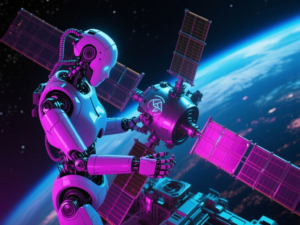
In a remarkable fusion of education and innovation, graduate student Sarah Downs has developed an algorithm that empowers robots to assemble satellites in space, specifically allowing them to insert antennas into designated slots. This advancement represents a significant step in tackling the longstanding challenge in robotics known as the peg-in-hole problem.
A Journey into Robotics
Sarah Downs, a graduate student in electrical engineering at Texas A&M University, has been passionate about robotics since her early teenage years. Her journey began in Tulsa, Oklahoma, where she participated in the First Lego League, igniting her interest in the field. Inspired by NASA’s Mars rovers and the live launch of the Curiosity rover, she aspired to contribute to space exploration.
For her master’s thesis at the University of Tulsa, Downs collaborated with NASA and the U.S. Air Force to create an algorithm that enables a robot to perform satellite assembly tasks without relying on visual systems. This approach is particularly crucial in the unpredictable environment of outer space, where traditional cameras may fail.
Innovative Assembly Techniques
Downs’ algorithm employs a force-based insertion method, allowing the robot to sense the position and orientation of objects in its environment. By utilizing a torque sensor on its gripper, the robot can detect the force feedback between the antenna and the satellite, guiding the assembly process with precision. This technique is essential for maintaining stability during the insertion, especially in the absence of gravity, where any unintended motion could jeopardize the satellite’s position.
“Without gravity, you now have to consider the arm’s reaction torques on the satellite to avoid flinging it into space,” Downs explains, highlighting the complexities involved in robotic assembly in zero-gravity conditions.
Future Aspirations
Currently pursuing her Ph.D. in electrical engineering, Downs is expanding her research on satellite assembly within the Robotic Space Simulator project at Texas A&M’s Robotics and Automation Design Lab. Her work is supported by Robert Ambrose, a NASA veteran, and aims to develop machines capable of operating in extreme environments.
After completing her doctorate, Downs hopes to work with NASA, focusing on the development of rovers for Mars sample collection and robotic arms for tasks on space stations. Her journey reflects a commitment to advancing robotics and contributing to humanity’s exploration of space.
This article was produced by NeonPulse.today using human and AI-assisted editorial processes, based on publicly available information. Content may be edited for clarity and style.