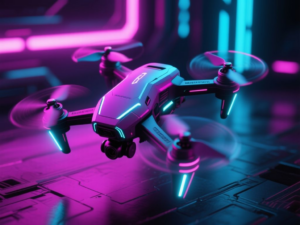
The world of drones is often characterized by their conspicuous presence, both in sound and sight. Yet, a new development from Northwestern University introduces a drone that challenges this norm: the Phantom Twist. This innovative drone is engineered to be nearly invisible, demonstrating a significant leap in drone design and functionality.
Revolutionary Design and Functionality
Presented at the RSS 2026 conference in Sydney, Phantom Twist employs a unique spinning mechanism to minimize its visibility. By rotating at speeds between 15 and 25 Hz, it exploits the limitations of human vision, creating a motion blur that renders it nearly undetectable. This phenomenon, known as persistence of vision, allows the drone to blend seamlessly into its surroundings.
Mechanics of Control
Despite its unconventional design, Phantom Twist is capable of controlled flight using a single motor. The drone’s movement is directed by modulating the motor’s speed during its rotation, enabling it to translate in various directions. Altitude is managed through adjustments in thrust, while its spinning nature provides passive stability. The construction includes carbon fiber rods, batteries, a controller, and a propeller, all arranged to optimize its low visibility.
Computational Optimization
The design process for Phantom Twist utilized advanced computational techniques to achieve its low visibility. An iterative optimizer was employed to minimize a metric known as Learned Perceptual Image Patch Similarity (LPIPS), which measures the difference between images of the drone and its background. The final design boasts an LPIPS score of 0.0104, significantly outperforming human-designed versions and conventional quadrotors, which are over ten times more visible.
Future Applications and Potential
Currently, Phantom Twist operates within a controlled environment using an optical tracking system. However, the research team is optimistic about adapting its design for outdoor flight. The drone’s unique spinning behavior may also enable innovative sensing capabilities, such as capturing 360-degree imagery for navigation and control. Potential applications include covert surveillance and wildlife observation, offering a less intrusive means of studying natural behaviors.
For those interested in the technical details, the research paper titled Computational Design of a Low-Visibility UAV Using a Human-Aligned Perceptual Metric will provide further insights into this groundbreaking project.
This article was produced by NeonPulse.today using human and AI-assisted editorial processes, based on publicly available information. Content may be edited for clarity and style.