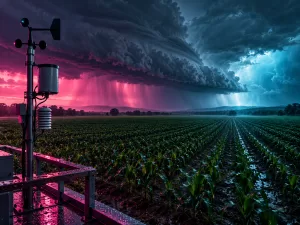
A farmer deciding when to plant cannot always wait for a three-day rain forecast. Subseasonal weather forecasting targets a harder window: two to six weeks ahead, when a useful warning could arrive before preparations become impossible.
In research highlighted by MIT on October 14, 2026, a team including Microsoft and university researchers tackles that gap by teaching machine learning to recognize a forecast model’s recurring mistakes. Their method is called Probabilistic Bias Correction, or PBC.
Correct the forecast, not the atmosphere
Small errors accumulate as weather models look further ahead. But uncertainty is not the same as complete ignorance: some errors repeat. PBC uses historical predictions and observed weather to adjust the probabilities an existing model assigns to future conditions.
The authors’ publicly available manuscript describes two complementary corrections: one learns biases that vary by location, date and probability category; the other blends predictions with recent observations and seasonal context. PBC works on the forecast distribution, preserving useful signals instead of simply pulling everything toward average weather.
It is an additional layer, not a replacement for the underlying dynamical or AI model. That leaves a practical test: better statistical scores still need to translate into useful decisions.
What improved in subseasonal weather forecasting
The manuscript’s central evaluations cover weekly temperature, precipitation and pressure on a global grid, with forecast windows spanning days 19–25 and 26–32. PBC doubled the modest average probabilistic skill of ECMWF’s subseasonal AI system in the reported comparison. That does not mean twice as many daily forecasts were correct, or that uncertainty vanished.
Competition results involve another system: MicroDuet, which combines PBC-corrected forecasts from ECMWF’s dynamical model and a hybrid model called PoET. Microsoft’s account of the work reports that this combined entry took first place across variables and lead times in the inaugural AI Weather Quest season.
The competition organizer’s own description makes the scope clear: it benchmarks probabilistic forecasts three to four weeks ahead, using a score relative to historical climate expectations. A competition win is not proof of exact storm timing six weeks out.
From a better score to an earlier decision
Microsoft says PBC is available as open-source software and is being piloted with Kenyan forecasters. Its commercial subseasonal service is in private preview, not a universal public rollout. The manuscript also reports improved extreme-weather prediction. Its broad-area evaluations should not be read as proof of precise warnings for every local hazard.
The promise is quieter than a perfect forecast: a better estimate of whether a week may be unusually wet, dry, hot or cold. For people managing crops, water or energy, that extra signal could change what they have time to do.