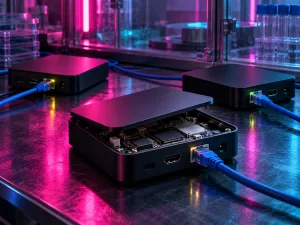
Fifteen off-brand Android TV boxes, costing about $55 each, ran a language model together at Anthropic. The October 12 research report asks whether everyday hardware could eventually support AI self-replication beyond data centers. It does not report an outbreak in homes.
Why several small boxes can share one model
The computing idea is not inherently malicious. Earlier Petals research demonstrated collaborative inference: different machines hold different model layers, passing intermediate results along a chain. This helps a group run a model that would not fit on one participant’s hardware.
Think of it as a relay rather than fifteen independent brains. That distinction matters: sharing the work of generating responses is not the same as autonomously recruiting new machines.
AI self-replication: what the test actually measured
Anthropic separately tested propagation across eight emulated Android nodes in a firewalled network. Access was deliberately simplified, without authentication. GLM-5.2 successfully orchestrated deployment of Llama3.1-8B, while its own inference ran elsewhere. This measured orchestration under favorable conditions, not a small model independently living and reproducing across consumer devices.
The company forecasts that sufficiently capable small models could emerge by the end of 2026 if historical improvements continue. It calls that timing a rough estimate based on a general capability index—not a direct measurement of future replication success.
These are findings from one company’s experiments, not independent confirmation of a deployed AI worm.
The useful response is still basic device security
The UK National Cyber Security Centre’s consumer guidance recommends replacing default passwords, enabling two-step verification where available, and promptly installing device and app updates. It also stresses knowing how long a product will receive security updates. Those controls address ordinary compromise; they do not depend on accepting an AI forecast.
Our assessment is that the next decisive evidence would combine realistic access barriers, local model execution and sustained propagation in one test. Until then, a successful computing demonstration and a successful simplified deployment chain should remain separate claims.
The question is no longer just where an AI is trained. It is also who controls the hardware on which it can keep running.