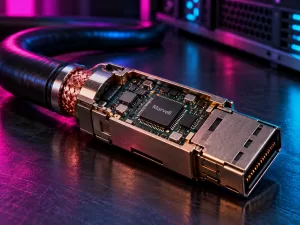
Between two AI servers, a copper cable still has to carry the conversation. Marvell copper interconnects are getting a new push: on October 13, 2026, the company announced two chips aimed at faster links inside AI racks.
The announcement pairs an Alaska E retimer rated for 3.2 terabits per second of aggregate bandwidth with a second-generation Alaska A signal processor for 1.6-terabit active electrical cables. Both are sampling to customers, rather than evidence of a completed rollout.
The signal needs more than a louder voice
Sending data faster does not make the transmission path disappear. Signal-conditioning chips address degradation along that path. A useful distinction comes from Texas Instruments’ technical explanation: a redriver compensates for channel loss, while a retimer also recovers timing and regenerates the signal. It is closer to reconstructing a sentence than turning up its volume.
TI’s document concerns PCIe, not a test of Marvell’s new parts. The general mechanism explains the appeal—and the trade-off. More sophisticated conditioning can add cost, power demands and integration complexity. A cleaner link is not a free link.
What Marvell copper interconnects are promising
Marvell specifies 16 lanes of 224G PAM4 signaling for Alaska E. For the new Alaska A, it claims 1.6-terabit throughput over copper reaches exceeding six meters, double its first-generation reach. Those are manufacturer specifications, not benchmarks conducted by NeonPulse.
Protocol support matters alongside distance. Marvell lists Ethernet, UALink and ESUN. The UALink Consortium’s specifications page describes its 200G 1.0 interconnect as connecting accelerators and switches at 200G per lane, with support for up to 1,024 accelerators in a computing pod. That is the standard’s scope—not a claim that these Marvell samples have already powered such a system.
A cable claim becomes a system question
The announcement does not establish that copper will replace optics, or that every cable assembly will achieve the advertised reach. Marvell is offering customers components to evaluate; system-level performance still needs verification.
The practical question is therefore bigger than cable length: can the completed link preserve enough signal while fitting the rack’s power, cooling and latency requirements? Faster processors only help when the connections let them work together.