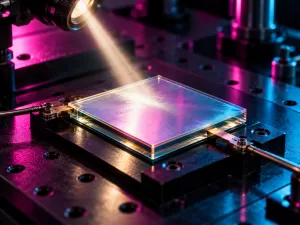
Under illumination, a solar cell can also send light back out. Researchers at Spain’s Institute of Photonic Sciences (ICFO) have improved organic solar cell efficiency by changing the directions in which that emission can escape, according to the institute’s October 5 announcement.
The experiment tackles a less intuitive loss than heat: the mismatch between sunlight arriving within a narrow cone and the cell emitting photons across a much wider range of angles.
A different route to organic solar cell efficiency
The team used a PM6:Y6 organic cell with silver electrodes and surrounding layers forming an optical cavity. The structure suppresses emission at large angles while allowing incoming sunlight through. ICFO reports an experimental efficiency improvement; its announcement does not give a numerical conversion efficiency for the device.
PV magazine’s October 9 coverage places the work in the broader effort to reduce these angular, or Boltzmann, losses.
The ceiling—and the distance still to travel
The researchers say narrowing emission could, in principle, allow efficiencies approaching 43%, beyond the conventional roughly 33% single-junction limit. That is a potential endpoint, not the measured output of this experiment. TechRadar’s October 11 report explicitly distinguishes the small gains observed in testing from that theoretical possibility.
A changed optical design also changes the assumptions behind the comparison. The proposal challenges the familiar operating configuration; it does not abolish energy conservation.
What would make it matter outside the lab?
More electricity from a given area is the attraction. Our reading is that the decisive next evidence would be a clearly quantified efficiency gain, followed by durability and manufacturing results for practical devices. Neither a forecast nor an elegant mechanism answers those questions alone.
The intriguing shift is where engineers look for extra power: the light leaving a cell may deserve as much attention as the light entering it.