For decades, the most precise clocks listened to electrons. Now two independent teams have made timekeeping systems lock onto something far smaller: a transition inside the nucleus of thorium-229. Their first operational nuclear clocks arrived in the same issue of Nature—a double result that turns a long-discussed idea into working hardware.
The achievement does not mean atomic clocks are obsolete. The new prototypes still trail the world’s best optical atomic clocks. What changed is more fundamental: the atomic nucleus has finally become a self-correcting reference that can steer a laser continuously, rather than a signal researchers observe only in short experiments.
How the first operational nuclear clocks work
Atomic clocks use a sharply defined energy transition in an atom’s electrons as their “tick.” Nuclear clocks move that reference inward, to protons and neutrons. Because the nucleus is more compact and less exposed to outside electromagnetic disturbances, physicists expect it could eventually support unusually stable measurements.
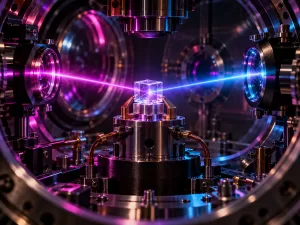
Both teams used thorium-229 embedded in calcium-fluoride crystals. Thorium-229 is exceptional because its low-energy nuclear transition can be reached with laser light. In the Vienna team’s paper, a continuous-wave laser at roughly 148 nanometers was automatically corrected whenever its frequency drifted away from the nuclear resonance. TU Wien reports that the system remained stable for more than 24 hours without intervention.
The Vienna prototype reached precision around 10−15, which the university describes as an error of roughly one second in 30 million years. That sounds almost absurdly exact, yet the researchers stress that it is not a world record. Better lasers and higher-quality crystals should be able to push it much further.
Two routes to the same nuclear beat
A separate collaboration led from China reported its own thorium-229 nuclear clock. The team developed a narrow-linewidth vacuum-ultraviolet laser and locked it to a resolved transition in the crystal. According to Tsinghua University, measurements from two independently manufactured crystals agreed at the 10−13 level.
The experiments use different strengths: the Vienna group emphasizes crystal quality and long autonomous operation, while the Chinese system uses a stronger laser and demonstrates reproducibility across crystals. Their near-simultaneous success matters because it suggests the concept is not tied to one fragile laboratory recipe.
Why physicists want a clock inside the nucleus
More precise and robust clocks could eventually improve navigation, telecommunications and scientific synchronization. But the deeper attraction is sensitivity. Comparing nuclear and atomic clocks might reveal whether constants assumed to be fixed subtly vary—or whether an unseen field associated with dark matter nudges them in different ways.
No dark matter was detected, and neither study delivers a deployable device. The milestone is narrower, but real: two laboratories made nuclei regulate a clock. If those clocks grow quieter and more precise, they may do more than measure time. They could turn timekeeping into a detector for physics we have not yet seen.