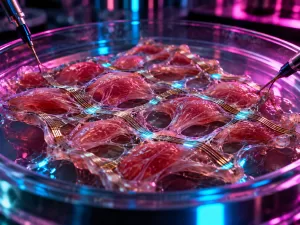
In a laboratory dish, human heart cells contracted around an ultrathin electronic mesh. Instead of merely measuring the movement, the mesh converted some of that mechanical energy into electricity. It is an intriguing result for a field still dependent on batteries—and a long way from a device that could power itself inside a patient.
A power source woven into living tissue
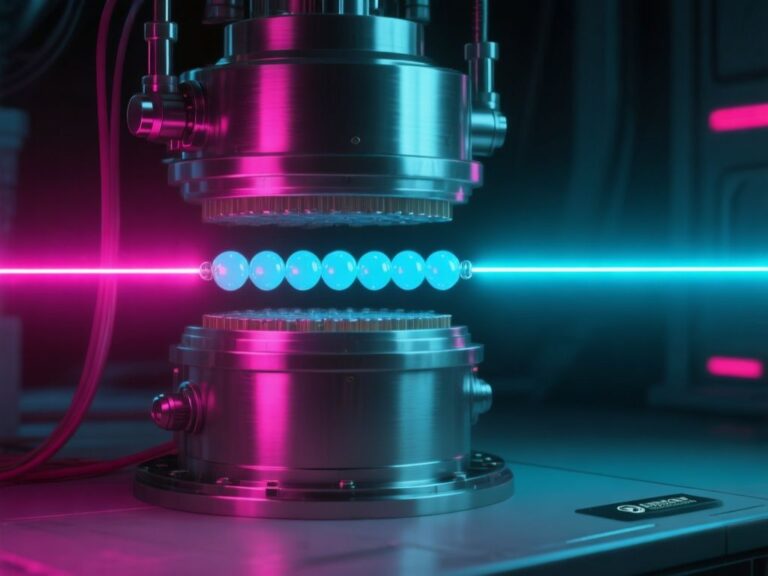
Researchers led by the University of Massachusetts Amherst described a biohybrid mesh harvester in Science Advances on October 7. Its small ribbons of lead zirconate titanate (PZT), a piezoelectric material, produce electrical output when mechanically deformed. The team placed those elements on an extremely thin, flexible polymer framework and grew human cardiac cells through and around it.
The distinction is architectural. A conventional energy harvester sits on a continuous substrate and collects movement at a relatively centralized point. This mesh distributes tiny harvesting elements through the tissue, allowing the material to move more closely with the contracting cells. In the university’s account, the researchers report roughly ten times the effective energy density of the centralized approaches they compared it with. That is a comparison between research designs—not proof that the mesh can power a commercial pacemaker.
Why the battery question matters
Implantable medical electronics need reliable energy over long periods. Batteries take up space, complicate miniaturization and may eventually need replacement. A device able to recover small amounts of energy from its surroundings could change those trade-offs. Medical-technology coverage has highlighted the potential for future implantable and wearable devices, but the research does not establish a clinical power source.
The central limitation is easy to miss: this experiment used lab-grown cardiac tissue, not an implanted device in a human body. The published abstract explicitly describes an in vitro demonstration and frames living-body use as a future possibility. Engineers would still need to establish long-term reliability, safe integration with tissues, usable output under real physiological conditions and the demands of a specific medical device.
What comes next?
Flexible layers could, in principle, be stacked or adapted to other ways of harvesting energy. But more energy on a laboratory bench is not the same as dependable power for life-critical electronics. The meaningful advance here is the design principle: rather than attach a rigid battery to living tissue, build the harvesting network to behave more like the tissue itself.
That shift might eventually make some implants smaller or longer-lived. For now, the breakthrough is a convincing laboratory prototype—and a new set of questions about what it takes to make electronics truly coexist with the body.