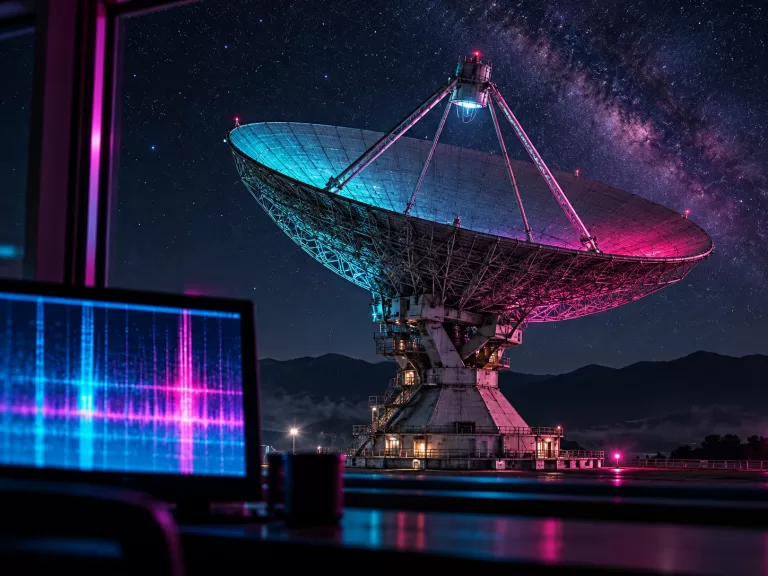
This week marks a significant milestone in astronomical research as the Vera C. Rubin Observatory officially begins its Legacy Survey of Space and Time (LSST), a project that has been in development for over two decades. This extensive survey aims to enhance our understanding of the solar system and the broader cosmos, focusing on phenomena such as dark energy, dark matter, and the universe’s expansion.
The Vera C. Rubin Observatory Gets to Work
Located in Chile, the Vera C. Rubin Observatory is equipped with the world’s largest digital camera, boasting an impressive 3,200 megapixels. The survey officially commenced on June 30, and for the next ten years, the observatory will capture a new image of the sky approximately every 40 seconds, covering the entire southern sky every few nights. This ambitious effort will result in an extensive time-lapse record of the universe.
During a test run last summer, the observatory successfully captured images of millions of galaxies and stars, along with thousands of previously unknown asteroids. Over the course of the LSST, each point in the sky will be revisited around 800 times, allowing researchers to document changes and cosmic events. The observatory is expected to generate around ten terabytes of data each day, taking approximately 1,000 images per night.
“Today, we begin filming the greatest cosmic movie ever made,” stated Brian Stone from the National Science Foundation. This mission is anticipated to redefine modern cosmology and astrophysics, with the potential to deepen our understanding of the fundamental laws governing existence, as emphasized by Darío Gil, Under Secretary for Science at the US Department of Energy.
Diving Suits for Cyborg Cockroaches
In an intriguing development from the realm of bioengineering, researchers from Nanyang Technological University Singapore and Waseda University have created a specialized diving suit that enables cyborg cockroaches to survive underwater for extended periods. These cyborg insects, specifically Madagascar hissing cockroaches fitted with electronic controllers, have been designed for potential use in search and rescue operations, capable of accessing areas that are difficult for humans or larger robots to reach.
The flexible diving suit features an oxygen-generation tank, a flexible shell, and four silicone tubes connected to the cockroaches’ spiracles—the openings through which they breathe. Remarkably, these tubes can be removed without causing harm to the insects. In tests published in Nature Communications, the cyborg cockroaches demonstrated the ability to swim underwater for up to 3 hours.
NASA’s Plans for Lunar Exploration
In another significant announcement, NASA has selected three companies—Astrobotic, Firefly Aerospace, and Intuitive Machines—to deliver payloads to the lunar surface as part of its plans for a $20 billion Moon Base. The first missions are set to occur before the end of 2026, with additional missions planned for late 2028.
The contracts, totaling nearly $600 million, will facilitate the delivery of scientific payloads, including a Stereo Camera for Lunar Plume Surface Studies (SCALPSS), a Laser Retroreflector Array (LRA), and a Linear Energy Transfer Spectrometer (LETS). These instruments are designed to gather critical data for future lunar exploration, with the goal of establishing a comprehensive environmental data network on the Moon.
“By flying the same science instruments on multiple landers, we will better understand potential hazards during landing,” noted Joel Kearns, deputy associate administrator for exploration at NASA. This approach aims to enhance safety and efficiency in human exploration of the lunar surface.
This article was produced by NeonPulse.today using human and AI-assisted editorial processes, based on publicly available information. Content may be edited for clarity and style.
Original source: engadget.com