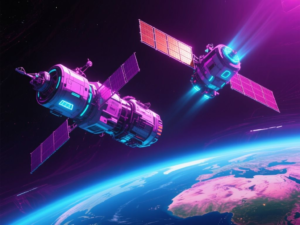
NASA has announced the selection of two next-generation satellite missions designed to deepen our understanding of Earth and enhance the ability to predict environmental events and mitigate disasters. According to Nicky Fox, associate administrator of the Science Mission Directorate at NASA Headquarters, these missions leverage the unique perspective of space to provide critical data that aids disaster response and informs future exploration across our solar system.
Fox emphasized that by studying Earth’s surface topography, ecosystems, and atmosphere, these missions will not only improve long-range weather forecasting but also ensure the safety of astronauts and spacecraft as humanity prepares to return to the Moon and venture to Mars.
STRIVE Mission Overview
The first mission, known as STRIVE (Stratosphere Troposphere Response using Infrared Vertically-resolved light Explorer), aims to deliver daily, near-global, high-resolution measurements of temperature, various atmospheric elements, and aerosol properties. This will be achieved from the upper troposphere to the mesosphere, with a spatial density surpassing any previous missions.
STRIVE will also measure vertical profiles of ozone and trace gases, which are essential for understanding the recovery of the ozone layer. The data generated by this mission is expected to support longer-range weather forecasts, a critical tool for protecting coastal communities where nearly half of the global population resides. The mission is led by Lyatt Jaeglé from the University of Washington in Seattle.
EDGE Mission Overview
The second mission, EDGE (Earth Dynamics Geodetic Explorer), will focus on observing the three-dimensional structure of terrestrial ecosystems, along with the surface topography of glaciers, ice sheets, and sea ice. This mission represents a significant advancement over current measurements obtained from NASA’s ICESat-2 (Ice, Cloud, and land Elevation Satellite 2) and GEDI (Global Ecosystem Dynamics Investigation).
Data from EDGE will provide insights into conditions affecting land and sea transportation corridors, terrain, and other commercially relevant areas. Helen Amanda Fricker from the University of California San Diego leads this mission.
Next Steps and Mission Parameters
Both missions will progress to the next phase of development, with a confirmation review scheduled for 2027. This review will evaluate the missions’ progress and funding availability. If confirmed, the total estimated cost for each mission, excluding launch expenses, will not exceed $355 million, with a planned launch date no earlier than 2030.
For further details about the Earth System Explorers Program, visit NASA’s dedicated page.
This article was produced by NeonPulse.today using human and AI-assisted editorial processes, based on publicly available information. Content may be edited for clarity and style.
Original source: nasa.gov