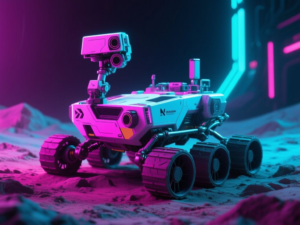
NASA is pushing the boundaries of robotic exploration with its latest prototype, the Exploration Rover for Navigating Extreme Sloped Terrain, known as Ernest. Recently tested in the Colorado Desert, this rover aims to overcome the limitations faced by its predecessors on the Martian surface.
Historically, NASA’s Mars rovers have been constrained by their slow speeds and the challenges posed by rugged terrain. For instance, the Perseverance rover, considered a standout in the fleet, reaches a maximum speed of just under 0.1 mph on flat ground. The difficulties of navigating steep slopes and rocky surfaces often necessitate lengthy detours, hindering exploration efficiency.
Innovative Design and Testing
Ernest, measuring four feet in length, is designed with four wheels—unlike the six-wheel configuration of current Mars rovers. Notably, it can individually lift its wheels, enabling it to step over obstacles with ease. During its recent testing, Ernest operated for over 37 hours across seven days, covering approximately 16 miles and achieving a top speed of about 0.6 mph. James Keane, a planetary scientist at JPL, remarked, “You could do a science road trip across the Moon — or Mars — with this vehicle.”
Active Suspension for Enhanced Mobility
Unlike previous rovers that utilized a passive suspension system, Ernest incorporates an active suspension mechanism. This system features two powered joints at the front, allowing the rover to adopt various gaits such as squirming, wheel-walking, and obstacle-climbing. Depending on the task and energy requirements, Ernest can switch between active and passive suspension modes. Its four steerable wheels grant it the ability to maneuver in any direction, significantly enhancing its operational flexibility.
Ongoing Development and Future Prospects
Since the program’s inception in 2022, multiple iterations of the Ernest prototype have been developed, with nearly a dozen active suspension configurations tested. The latest version boasts improved independent decision-making capabilities, aiming to reduce reliance on human operators on Earth. The overarching goal is to create rovers that can traverse greater distances more quickly, paving the way for future missions on Mars and beyond.
This article was produced by NeonPulse.today using human and AI-assisted editorial processes, based on publicly available information. Content may be edited for clarity and style.
Original source: engadget.com