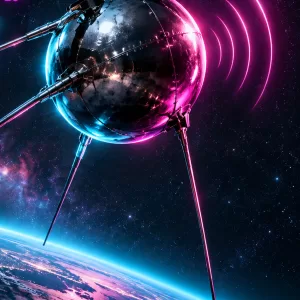
In October 1957, a radio beep from above Earth announced a startling fact: the Soviet Union had placed an object in orbit. The signal was simple. The stakes were not. The satellite showed that a rival power could reach space, and observers connected that achievement to the possibility of new weapons. The alarm concerned what the launch capability implied, rather than a weapon aboard Sputnik. Sputnik – 60 years of the space age 65 Years Ago: Sputnik Ushers in the Space Age
That object was Sputnik 1, the first human-made Earth satellite, launched on 4 October 1957. NASA describes shock and amazement in the United States, followed by congressional hearings and the creation of NASA in 1958. A small machine became evidence of a much larger contest over scientific and military capability. 65 Years Ago: Sputnik Ushers in the Space Age
Why World Space Week begins with Sputnik
World Space Week runs from 4 to 10 October because its dates connect the space age to both its dramatic beginning and its first major rulebook. The United Nations designated the annual observance in 1999 through resolution 54/68. The opening date recalls Sputnik; the closing date marks the Outer Space Treaty entering into force in 1967. World Space Week The Outer Space Treaty
The same orbit carried fear and opportunity
The lasting change was practical: once an object could circle Earth and send a signal across borders, orbit became useful for more than prestige. ESA links the early satellite era to proposals for satellite navigation, later Earth observation and space-based scientific instruments. That development affects ordinary life through systems that help determine position, study the planet and gather knowledge beyond it. Sputnik – 60 years of the space age
A frontier governments tried to restrain
The Outer Space Treaty followed the shock with limits on national appropriation and on placing nuclear weapons or other weapons of mass destruction in orbit. It also assigns states responsibility for space activities carried out by governmental and nongovernmental actors. The treaty did not settle every military question, but it established that orbital capability would need rules as well as engineering. The Outer Space Treaty
In 2026, World Space Week uses the theme “Rocket Revolution,” a celebration of changing access to orbit. The beep mattered because it made space impossible to treat as a remote spectacle: power, knowledge and shared rules would all be shaped above Earth. World Space Week Association