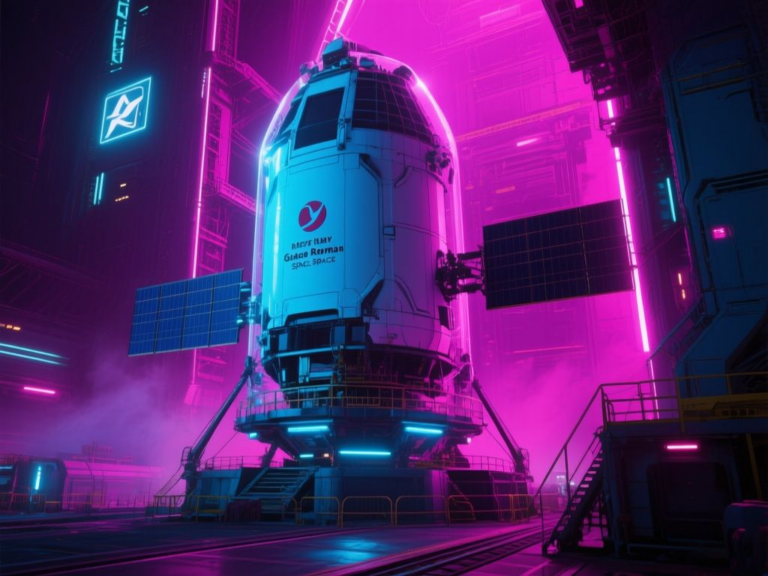
NASA’s Nancy Grace Roman Space Telescope is scheduled for launch on Sunday, embarking on a transformative mission valued at $4.3 billion. Utilizing a donated Hubble-class mirror originally designed for a classified satellite, Roman will capture wide-angle, ultra-sharp images that would require half a million 4K TVs to display in full.
With a 300-megapixel wide-field camera, a single full-resolution image from Roman could cover 45 city blocks or the entirety of El Capitan in Yosemite National Park. This advanced telescope is set to collect data at an astonishing rate, downlinking 2,500 terabytes over its five-year primary mission—equivalent to the total data returned by the Hubble Space Telescope in its 30-year history.
Launch Preparations and Specifications
The telescope will be launched aboard a SpaceX Falcon Heavy rocket from Kennedy Space Center at 7:26 a.m. EDT. The mission will take Roman to Lagrange Point No. 2, approximately one million miles from Earth, where it will maintain its position with minimal fuel use. This location is also home to the James Webb Space Telescope, allowing both observatories to study the cosmos from a stable vantage point.
Scientific Goals and Capabilities
Roman’s mission aims to deepen our understanding of dark matter and dark energy, fundamental components of the universe that influence its structure and expansion. NASA Administrator Jared Isaacman emphasized that Roman will create “a new atlas of the universe,” while NASA science chief Niki Fox described it as “a sheer powerhouse” capable of scanning the sky at unprecedented speeds.
In addition to its wide-field camera, Roman is equipped with an advanced coronagraph that will enable it to detect exoplanets by blocking out the glare of stars. This instrument is expected to identify Jupiter-sized planets around Earth-like stars, potentially analyzing their atmospheric compositions.
Addressing Cosmic Mysteries
Roman’s observations will also tackle the Hubble Tension, a discrepancy in the measurement of the universe’s expansion rate. Project Scientist Julie McEnery noted that the telescope could reveal inconsistencies in our current cosmological models, possibly indicating that dark energy is not a constant force but may vary over time.
Over its five-year mission, Roman will conduct three core surveys, including the High-Latitude Wide-Area Survey, which aims to catalog over a billion galaxies. The telescope’s capabilities could lead to the discovery of more than 100,000 exoplanets within just 18 months of observations.
As the mission unfolds, Roman is expected to deliver groundbreaking insights into the fundamental nature of the universe, paving the way for future explorations and discoveries.
This article was produced by NeonPulse.today using human and AI-assisted editorial processes, based on publicly available information. Content may be edited for clarity and style.