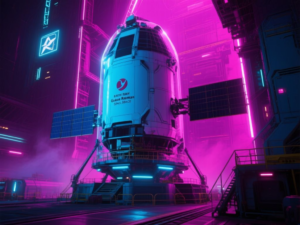
NASA is gearing up for the launch of the Nancy Grace Roman Space Telescope, scheduled for no earlier than 7:26 a.m. EDT on August 30, 2026. This next-generation observatory, named after NASA’s first chief astronomer, will lift off aboard a SpaceX Falcon Heavy rocket from Launch Complex 39A at the Kennedy Space Center in Florida.
The Roman Space Telescope is designed to tackle some of the universe’s most profound mysteries, particularly those surrounding dark energy and dark matter. With a field of view at least 100 times larger than that of the Hubble Space Telescope, Roman will conduct extensive surveys to discover and characterize exoplanets, map billions of galaxies, and study black holes, among other objectives.
Mission Overview
Once launched, the Roman telescope will travel to the second Sun-Earth Lagrange point (L2), located approximately one million miles from Earth. The mission is expected to have a primary operational lifetime of five years, with a goal of extending to ten years. All scientific data collected will be made publicly available after processing.
Launch Coverage Details
NASA has outlined comprehensive coverage plans for the prelaunch and launch activities. Coverage will commence at 6:20 a.m. EDT on launch day, with live streaming available across various platforms. A series of briefings and conferences will take place leading up to the launch:
- August 29, 2026 – Mission Science Briefing at 9 a.m.
- August 29, 2026 – Prelaunch News Conference at 10:30 a.m.
- August 30, 2026 – Postlaunch News Conference at 9:30 a.m.
Media will have opportunities to ask questions during these events, either in person or via phone.
Collaborative Efforts
The Roman telescope project is managed by NASA Goddard Space Flight Center, with contributions from the Jet Propulsion Laboratory, Caltech/IPAC, and the Space Telescope Science Institute. Key industrial partners include BAE Systems Inc., L3Harris Technologies, and Teledyne Scientific & Imaging. International collaboration involves contributions from the European Space Agency, Japan Aerospace Exploration Agency, and other institutions.
For further details on the Roman Space Telescope, visit NASA’s official page.
This article was produced by NeonPulse.today using human and AI-assisted editorial processes, based on publicly available information. Content may be edited for clarity and style.