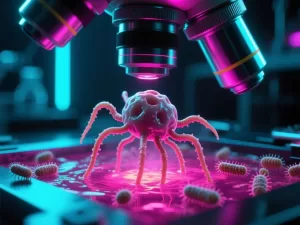
In a hot-spring tributary in Lassen Volcanic National Park, a newly described amoeba does something that once seemed close to impossible for complex cells: it hunts bacteria and divides at 63°C. Incendiamoeba cascadensis remains active at 64°C, according to a Cell paper published September 22, 2026. The report identifies a new observed upper temperature record for eukaryotic growth, not a record for life in general. Cell: A geothermal amoeba sets a new upper temperature limit for eukaryotes
That distinction matters because eukaryotes are cells with membrane-bound nuclei and organelles—the cellular architecture shared by amoebas, plants, animals and fungi. Earlier documented eukaryotic growth limits were around 60°C in some algae and fungi. Bacteria and archaea, which lack that architecture, include species that tolerate substantially higher temperatures. Reuters: Hot-springs amoeba sets heat-tolerance record
A hunter, not a heat-powered machine
The amoeba is not drawing energy directly from the heat. It feeds on heat-loving bacteria in its microbial niche. Its advantage is the ability to keep its own complex cell working while its prey survives nearby, turning a hostile spring into a functioning food web. Reuters: Hot-springs amoeba sets heat-tolerance record
At higher temperatures, the difference between growth and survival becomes crucial. After exposure to 70°C, cells could enter a protective dormant state and later recover under suitable conditions. That is not reproduction at 70°C: the observed division occurred at 63°C, with activity at 64°C. bioRxiv preprint: A geothermal amoeba sets a new upper temperature limit for eukaryotes
The cell changes before it gives way
Researchers observed the amoeba changing shape and forming a protective layer. They also reported changes in gene activity linked to DNA repair, internal transport and protein stability. Those observations point to several lines of protection rather than a single switch that explains the record. bioRxiv preprint: A geothermal amoeba sets a new upper temperature limit for eukaryotes
The enduring mechanism is cellular damage control. Heat can disrupt proteins, membranes and the systems that move material inside a cell. This amoeba appears to alter its structure and activity as conditions worsen, but the study does not identify one complete recipe for that tolerance. The contribution of individual genes and cell structures remains under investigation. Cell: A geothermal amoeba sets a new upper temperature limit for eukaryotes Science News: Fire amoeba thrives at record-breaking heat
A boundary moved, not erased
The finding does not establish a universal absolute temperature ceiling for all eukaryotes. It shows that at least one geothermal lineage can grow beyond the previous documented range. A boundary that looked firm was instead a limit of observation—one that a predator in a volcanic landscape has now pushed higher. Cell: A geothermal amoeba sets a new upper temperature limit for eukaryotes Reuters: Hot-springs amoeba sets heat-tolerance record