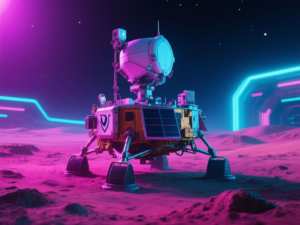
On July 20, 1976, NASA’s Viking 1 lander made history by successfully landing on Mars, marking 50 years since this significant milestone in space exploration. Launched on August 20, 1975, Viking 1 entered orbit around Mars on June 19, 1976, and became part of one of NASA’s most ambitious and costly robotic missions.
Mission Overview
The Viking program consisted of two spacecraft, with Viking 1 being the first to land on Martian soil. The mission was initially planned to coincide with the US Bicentennial on July 4, 1976, but was postponed to July 20 to ensure a safer landing site, which also coincided with the seventh anniversary of the Apollo 11 lunar landing.
Technological Innovations
Equipped with an ablative heat shield for atmospheric entry, Viking 1 utilized parachutes to slow its descent and retro-rockets to ensure a safe landing on Chryse Planitia. The lander was notable for its ability to perform soil sampling using a robotic arm and an onboard biological laboratory. Although NASA reported no definitive signs of life, the experiments revealed unexpected chemical activity, leading to ongoing debates about the data collected.
Longevity and Challenges
Viking 1 was powered by a Radioisotope Thermoelectric Generator (RTG), which allowed it to operate well beyond its initial 90-day mission, with its last transmission received on November 11, 1982. However, a command error in January 1982, related to battery management, ultimately led to the loss of communication. Engineers attempted to extend the lander’s battery life but inadvertently overwrote critical memory locations, causing the high-gain antenna to lose its alignment with Earth.
Legacy of Viking 1
While Viking 1 was not the first spacecraft to achieve a soft landing on Mars—an honor held by the Soviet Union’s Mars 3 in 1971—it significantly outperformed its predecessor by providing years of data and stunning imagery of the Martian landscape. The mission’s success was a testament to NASA’s capabilities in space exploration, coming just seven years after the first crewed lunar landing.
This article was produced by NeonPulse.today using human and AI-assisted editorial processes, based on publicly available information. Content may be edited for clarity and style.
Original source: theregister.com