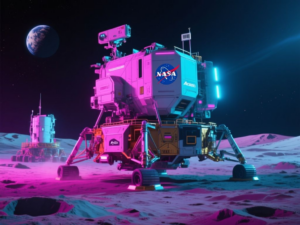
NASA is on the brink of its long-anticipated return to the lunar surface, marking the first time since Apollo 17 in 1972. This historic event is scheduled for 2028 with the launch of Artemis IV, which will send four astronauts to lunar orbit using the Space Launch System (SLS) and Orion spacecraft.
Before this mission, NASA plans to conduct a demonstration mission in Earth orbit next year. This mission will serve as a “dress rehearsal” for lunar landings, allowing Artemis astronauts to practice rendezvous and docking operations with a commercial Human Landing System (HLS), alongside teams on Earth.
Commercial Partnerships and Test Vehicles
NASA is collaborating with two commercial partners, SpaceX and Blue Origin, to develop the landing systems for both Artemis III and IV. Data from this upcoming mission, along with an uncrewed demonstration at the Moon, will be crucial for ensuring the safety and success of future crewed lunar landings.
For Artemis III, both SpaceX and Blue Origin will launch test versions of their crewed vehicles separately using their own rockets. The Artemis III crew will ascend to Low Earth Orbit (LEO) aboard an Orion spacecraft atop an SLS rocket. SpaceX will utilize the latest version of the Starship (V3), while Blue Origin will test their Mark 2 Blue Moon lander, applying insights gained from previous lunar missions.
Mission Preparations and Objectives
The mission will incorporate essential systems, including the Environmental Control and Life Support System (ECLSS), a crew cabin, and avionics. Upon rendezvousing with the HLS, two crew members will don Orion Crew Survival System (OCCS) suits, open the hatch, and enter the landing craft. The Blue Origin lander will also carry a lunar surface spacesuit mass simulator, similar to the “Moonikin” used in the uncrewed Artemis I test flight, equipped with instruments to provide real-time feedback about the crew cabin environment.
Launch and Testing Sequence
The Artemis III crew will conduct rendezvous and docking operations with the lander test articles before safely returning to Earth. NASA, SpaceX, and Blue Origin will execute ground processing, launch operations, and data exchange across various sites. Blue Origin’s test vehicle will remain in a “parking orbit” for up to 30 days to perform system checks prior to the SLS and Orion launch.
Following the completion of Blue Origin’s operations, the Starship HLS test vehicle will launch and rendezvous with the crew for its testing phase. The Orion spacecraft will maintain a circular orbit to facilitate efficient launch opportunities. Both SpaceX and Blue Origin have already demonstrated their docking capabilities with NASA.
As Jeremy Parsons, the Artemis program’s manager, stated: “Artemis III will be a highly choreographed dance with a demanding launch sequence across multiple launch pads and equally demanding mission operations for our ground and flight crews.” This demonstration mission is poised to set the stage for humanity’s next giant leap into lunar exploration.
This article was produced by NeonPulse.today using human and AI-assisted editorial processes, based on publicly available information. Content may be edited for clarity and style.