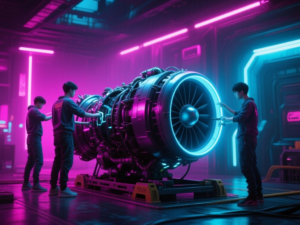
In a groundbreaking experiment, MIT students engaged in the JARVIS Challenge, a competition designed to assess the role of AI copilots in the demanding field of aerospace engineering. The challenge tasked undergraduates with the design, construction, and testing of a jet engine, utilizing AI as a primary engineering partner.
The Challenge Unfolds
Over four weeks, student teams were given the objective to create a “JARVIS-class” single-spool jet engine capable of producing 50–100 pounds of thrust. They had the freedom to choose their designs, materials, and fabrication methods. This initiative drew participation from 31 students across various engineering disciplines, many of whom had limited prior experience with gas turbines or thermodynamics.
AI as a Collaborative Tool
Throughout the challenge, students leveraged MIT’s machine shops, commercial software, and the newly launched MIT Parley platform, which aggregates large language models (LLMs). This allowed teams to interact with AI tools effectively, gaining insights into their design processes. However, the competition also highlighted the limitations of AI. While tools like Claude and ChatGPT assisted in generating design alternatives and summarizing information, students encountered challenges related to AI’s inaccuracies and lack of physical understanding.
Successes and Lessons Learned
Ultimately, two teams, Fast and Fractured and 811 Crew, completed their engine tests. The 811 Crew emerged victorious, successfully igniting their engine and transitioning to Jet-A fuel. Their success was attributed to a blend of prior knowledge and teamwork, demonstrating that while AI can enhance productivity, human expertise remains crucial. Professor Andreea Bobu noted that effective use of AI requires both the expertise to judge its outputs and the curiosity to explore its capabilities.
Conclusions from the JARVIS Challenge
The JARVIS Challenge underscored the potential of AI to accelerate engineering processes while emphasizing the importance of human judgment and foundational knowledge. As Professor Masha Folk remarked, the challenge showcased the possibilities when AI-enabled design meets motivated students in a culture of rapid experimentation. The findings suggest that while AI can serve as a powerful tool in engineering, it cannot replace the essential human elements of accountability and expertise.
This article was produced by NeonPulse.today using human and AI-assisted editorial processes, based on publicly available information. Content may be edited for clarity and style.
Original source: news.mit.edu