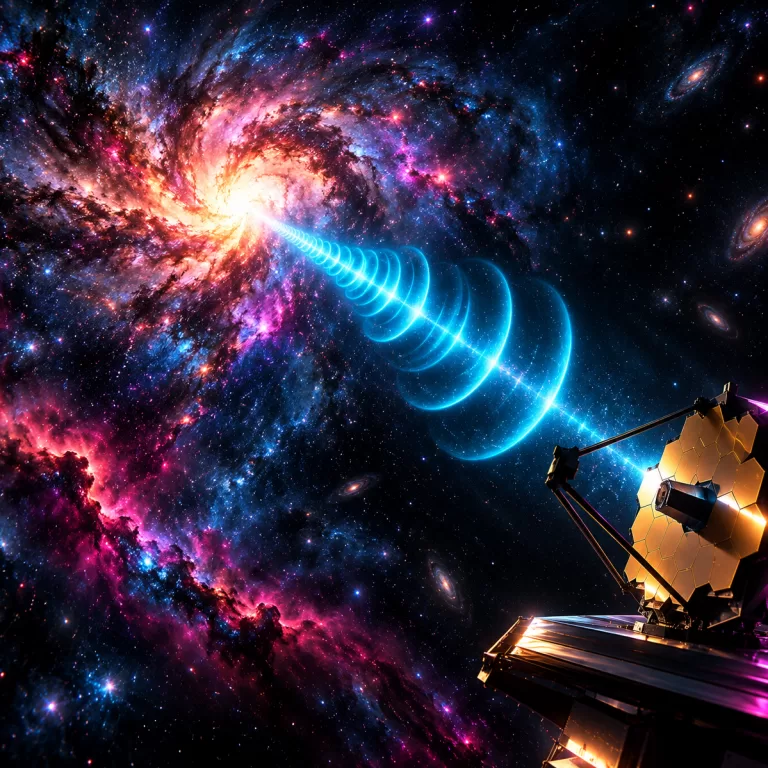
An international team utilizing the Australian Square Kilometer Array Pathfinder (ASKAP) Telescope has made a significant breakthrough by identifying a star system that serves as a natural laboratory for studying extreme physics. This system features a white dwarf that is actively pulling material from its larger companion, a red dwarf star, resulting in powerful bursts of radio waves and X-rays that repeat every 1.4 hours.
The discovery is particularly notable as it clarifies the source of a class of mysterious cosmic signals known as long-period radio transients (LPTs). These coherent bursts of polarized radio emission have puzzled astronomers for over two decades, and the identification of this system, designated ASKAP J1745−5051, marks a significant advancement in understanding their origins.
Details of the Binary System
The binary system consists of a white dwarf and a red dwarf star with a mass of approximately 0.10 Solar masses, orbiting each other in a period of just over an hour. The research was led by PhD student Kovi Rose from the University of Sydney and the Commonwealth Scientific and Industrial Research Organization (CSIRO), with contributions from various international institutions.
Understanding Long-Period Radio Transients
Unlike Fast Radio Bursts (FRBs), which last for milliseconds to a few seconds, LPTs can persist for minutes to hours. Initial theories suggested that these signals originated from slow-spinning neutron stars known as magnetars, but current models indicate that such signals are unlikely to arise from magnetar systems. Instead, the evidence now supports the idea that they originate from binary systems like ASKAP J1745−5051.
Implications of the Discovery
This discovery reinforces the hypothesis that LPTs are linked to binary systems. ASKAP J1745−5051 is only the second known long-period radio transient to emit X-rays regularly, and it is the first instance where the cause of this regularity has been confirmed. Rose stated, “For the first time, we have pinpointed the origin of these signals, confirming the source to be a ‘cataclysmic variable,’ or an accreting white dwarf star.”
The unique characteristics of ASKAP allow astronomers to detect unusual signals that might otherwise go unnoticed. The interaction between the magnetic fields of the two stars and the heated material drawn from the red dwarf results in tightly beamed bursts of radio waves, which repeat at regular intervals. This system provides a critical opportunity to explore extreme physics, enabling scientists to test theories regarding matter behavior in strong magnetic fields and intense gravitational forces.
Looking ahead, the research team plans to combine radio, optical, and X-ray observations of ASKAP J1745−5051 to further enhance the understanding of LPTs. Rose remarked, “Each new discovery is helping us piece together the bigger picture. We’re only just beginning to understand this new class of cosmic events.”
This article was produced by NeonPulse.today using human and AI-assisted editorial processes, based on publicly available information. Content may be edited for clarity and style.
Original source: universetoday.com