The dwarf planet Ceres, once classified as the first named asteroid, has unveiled a surface that is significantly more complex than earlier assessments suggested. This conclusion arises from new data presented at the European Geosciences Union 2026 General Assembly in Vienna, stemming from NASA’s Dawn mission.
Analysis of the data indicates that Ceres features steep slopes, fractures, and variations in albedo, which complicate the identification of craters. Since its discovery in 1801 by Giuseppe Piazzi, Ceres has intrigued astronomers, particularly after its reclassification as a dwarf planet in 2006 due to its size and differentiated interior. Unlike most asteroids, Ceres possesses a core, mantle, and crust, making it a subject of scientific interest.
Gravity Anomalies and Subsurface Brines
During the latter part of the Dawn mission, researchers conducted a detailed re-examination of the gravity field in the Occator crater region. This analysis revealed a gravity anomaly at a depth of approximately 50 km, suggesting the presence of less dense material interpreted as a subsurface reservoir of brines, according to Alicia Neesemann, a remote sensing analyst and planetary scientist at Freie Universität Berlin.
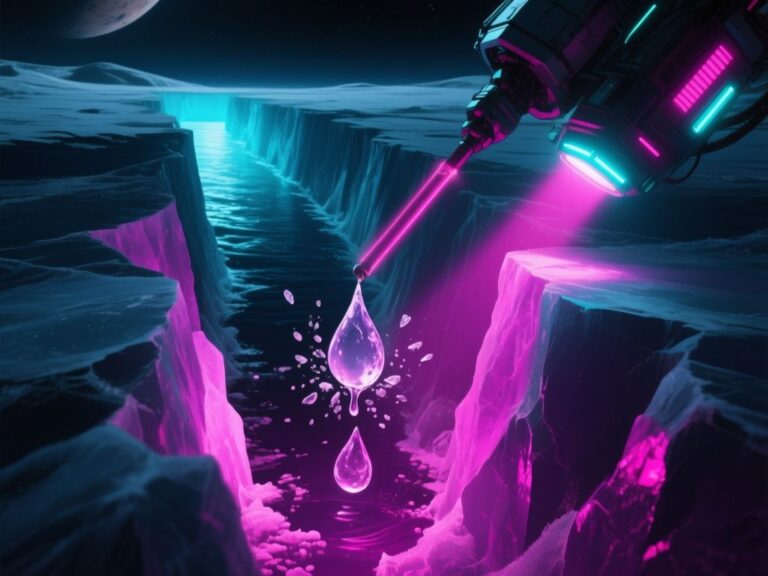
These brines likely ascended through fractures created by the impact that formed Occator, erupting at the surface and leaving behind remnants visible today as the evaporite deposits Cerealia Facula and Vinalia Facula. The impactor that created Occator struck Ceres an estimated few million to 20 million years ago, resulting in a crater approximately 92 km wide. Neesemann notes that Occator is the youngest crater of its size on Ceres.
Implications of Cryovolcanism
The bright deposits within Occator Crater are indicative of recent endogenic activity, likely linked to cryovolcanic and hydrothermal processes associated with subsurface brines. Understanding the absolute model age of these deposits is crucial for deciphering the geologic evolution of Occator and the thermal history of Ceres. The presence of a salty subsurface brine pocket lowers the freezing point of water, allowing it to ascend to the surface.
Cryovolcanism on Ceres occurs at temperatures well below zero, differing significantly from traditional volcanism, which happens at high temperatures. Neesemann explains that large impacts generate substantial heat, likely facilitating the ascent of brine water to the surface in cryovolcanic eruptions.
Future Exploration of Ceres
While the possibility of preserved microfossils within Ceres’ brine pocket remains unlikely due to potential mechanical destruction or chemical alteration during ascent, Neesemann is involved in a working group for a potential NASA JPL Ceres sample return mission. This mission would utilize an orbiter and lander to capture high-resolution images, essential for assessing landing safety on bright deposit areas.
Ceres’ surface gravity, at 5.7 times less than the Moon, presents a more favorable environment for landing compared to smaller asteroids like Bennu or Ryugu, where successful landings have already occurred. Consequently, sampling Ceres could resemble a planetary mission rather than a typical asteroid sample-return mission.
This article was produced by NeonPulse.today using human and AI-assisted editorial processes, based on publicly available information. Content may be edited for clarity and style.
Original source: universetoday.com