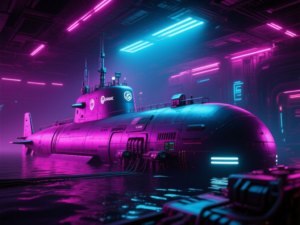
Submarine technology has a long history, dating back to its early, rudimentary forms. The fundamental concept is straightforward: a well-sealed vessel can submerge and resurface. However, the practical challenges involved in this operation have made it complex. The first recorded use of submarines in combat occurred during the US Civil War, where these primitive machines had limited endurance and navigational capabilities.
During World War I, substantial advancements in submarine technology emerged, particularly with the introduction of modern “U-boats” by Germany. These innovations allowed submarines to operate underwater longer than ever before, establishing the sneak attack as a critical tactic in naval warfare. However, a significant challenge remained: underwater communications.
Seawater’s density and conductivity severely hinder radio wave propagation, rendering high-frequency (HF) radio communications ineffective beyond a few meters underwater. Consequently, submarines had to surface to communicate, which limited their operational endurance while submerged.
Early Attempts at Underwater Communication
The Navy began exploring electronic communication methods as early as 1887, experimenting with wave conduction through seawater. Despite initial attempts, the technology did not yield satisfactory results until the development of wireless transmitters in the late 19th century. By 1903, the Navy had acquired its first radio sets, recognizing the potential of radio in naval combat.
In 1909, C-class submarines like Stingray and Tarpon were tasked with evaluating radio equipment. However, these evaluations faced numerous setbacks, with equipment failures hindering progress. Notably, the Narwhal attempted underwater communication using direct conduction technology, but initial tests were unsuccessful. Subsequent experiments yielded better results, demonstrating that radio signals could penetrate seawater, albeit only to a limited extent.
The Breakthrough with Long-Wave Radio
A significant breakthrough occurred in 1917 when John Willoughby, an engineer at the National Bureau of Standards, inadvertently discovered that low radio frequencies below 30 kHz were less affected by seawater. Collaborating with fellow engineer Percival Lowell, they developed a prototype for long-wave radio communication. Their experiments proved successful when they demonstrated that submarines could communicate while submerged.
By 1918, the Navy had adopted long-wave radio as a standard communication method for submarines. This technology allowed for reliable communication both underwater and at the surface, marking a pivotal advancement in naval operations.
Advancements in VLF Technology
As the decades progressed, the Navy expanded its long-wave communication capabilities, constructing high-power radio stations designed specifically for submarine use. One notable installation was NSS in Annapolis, Maryland, which became a key station for submarine command and control during the 1920s.
In 1961, the VLF Transmitter Cutler was established in Maine, featuring a unique design with two antennas supported by 13 towers. This facility remains operational today, representing the culmination of over a century of advancements in submarine communication technology.
This article was produced by NeonPulse.today using human and AI-assisted editorial processes, based on publicly available information. Content may be edited for clarity and style.
Original source: computer.rip