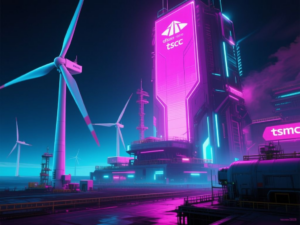
Taiwan Semiconductor Manufacturing Company (TSMC) is experiencing unprecedented profits driven by the surge in demand for AI chips. In response to a global energy crisis, TSMC is actively pursuing renewable energy sources, particularly wind power.
Corporate Power Purchase Agreement
Recently, TSMC entered into a 30-year corporate power purchase agreement with Northland Power, a Canadian energy producer, to secure 100 percent of the energy generated by the Hai Long offshore wind project. This initiative encompasses over 1 gigawatt of power capacity across three offshore wind sites in the Taiwan Strait, off Taiwan’s central western coast. Once operational, the project is expected to supply electricity equivalent to the needs of more than 1 million Taiwanese households.
Energy Crisis Context
The urgency of this agreement is underscored by recent disruptions in global energy supplies, particularly following the conflict in the Middle East, which has impacted natural gas shipments through the Strait of Hormuz. In March 2026, Qatar’s natural gas production was significantly affected by drone strikes, leading to a loss of one-third of Taiwan’s liquefied natural gas supply. Taiwan’s energy infrastructure, which relies on natural gas for about half of its electricity generation, faced a critical situation, with only two weeks of fuel reserves available.
Government Response and Future Plans
In light of these challenges, Taiwan’s government has sought alternative energy sources, including natural gas from Australia and the United States, to maintain supply stability. Additionally, the administration is accelerating efforts to diversify energy sources, which includes plans to restart nuclear power plants and expand renewable energy projects. Taiwan aims to achieve 15 gigawatts of offshore wind capacity by 2035.
TSMC has set ambitious targets for its energy consumption, aiming for 60 percent of its global operations to be powered by renewable energy by 2030, with a goal of reaching 100 percent by 2040. The company’s energy requirements are significant, accounting for nearly 10 percent of Taiwan’s total electricity consumption in 2023, a figure projected to rise to nearly 25 percent by 2030 due to increased manufacturing demands for AI chip production.
Previous Renewable Energy Initiatives
In addition to the Hai Long project, TSMC has previously secured agreements for renewable energy, including a 920 megawatt power purchase agreement with Ørsted for the Greater Changhua offshore wind farm, set to be fully operational in 2026. Furthermore, a deal with WPD in 2021 aims to develop over 1 gigawatt of onshore and offshore wind power.
This article was produced by NeonPulse.today using human and AI-assisted editorial processes, based on publicly available information. Content may be edited for clarity and style.
Original source: arstechnica.com