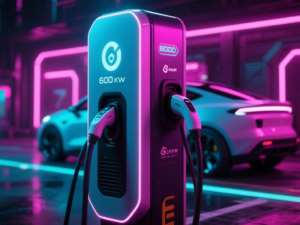
ChargePoint has introduced the Express Solo DC fast charger, designed to address one of the primary concerns for electric vehicle (EV) users: charging speed. This compact charger is engineered to operate with direct current (DC) power, facilitating installation in confined spaces while delivering a peak output of 600 kW.
The advancement in battery technology, as highlighted by recent developments from companies like CATL, indicates that EV batteries are becoming increasingly efficient. With the capability to charge at rates up to 1.5 MW, as seen with BYD’s Blade battery, the introduction of the Express Solo positions ChargePoint ahead of current U.S. charging infrastructure, where Tesla Superchargers max out at 250 kW and Electrify America at 350 kW.
Charging Capabilities
The Express Solo can charge two vehicles simultaneously, distributing the 600 kW output between them or directing the full power to a single vehicle. It features ChargePoint’s “Omni Port,” which includes both CCS1 and NACS connectors, ensuring broad compatibility with various EV models.
Direct DC Inputs and Modularity
One of the key innovations of the Express Solo is its ability to accept direct DC inputs, such as those from on-site energy storage systems. This design eliminates the need for expensive inverters, making it a cost-effective solution for operators. ChargePoint claims that the Express Solo is approximately 30 percent cheaper to purchase and operate compared to existing high-power chargers.
Future-Proofing Charging Stations
The modular architecture of the Express Solo allows for scalability, with the potential to expand from two to four plugs, and support for up to eight plugs planned for the future. ChargePoint CEO Rick Wilmer emphasized that this system not only enhances power output but also redefines the economics of DC fast charging, transforming it into a flexible energy platform.
Additionally, the Express Solo’s design enables bidirectional power flow, allowing an EV to supply energy back to the storage system, further enhancing its utility in various charging scenarios.
This article was produced by NeonPulse.today using human and AI-assisted editorial processes, based on publicly available information. Content may be edited for clarity and style.
Original source: arstechnica.com