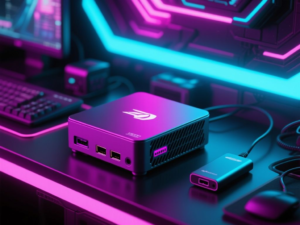
Mini PCs have gained popularity as compact alternatives to traditional desktops and laptops, suitable for various tasks from office work to intensive AI model refinement. However, the pricing of these devices often does not reflect their true cost when essential accessories are factored in.
Understanding Mini PC Pricing
The trend of mini PCs, particularly those in the mini ITX form factor, often sees a significant price increase as their size decreases. This is largely due to the engineering challenges involved in creating high-performance components that fit into smaller chassis. Surprisingly, many mini PCs are priced similarly to mid-range peripherals, which can lead to unexpected expenses.
The Barebones Tax
Many mini PCs, such as the Intel NUC series, are sold in a barebones configuration, meaning they come without RAM or storage. For instance, a decent 16GB RAM kit and a terabyte of solid-state storage can easily add at least $100 to the initial cost. Additionally, users must consider the operating system, with a Windows 11 Home license retailing around $140, although cheaper options exist.
For those transitioning from a traditional desktop, peripherals like a monitor, keyboard, and mouse are also necessary. A basic 24-inch monitor can cost around $100, while a decent keyboard and mouse combo might add another $50. Thus, the total cost for essential components can reach approximately $400 before even booting the system.
Essential Accessories for Functionality
After initial setup, users often discover the limitations of budget mini PCs, particularly in terms of connectivity. Many models offer a limited number of USB ports, which may not suffice for all peripherals. To expand connectivity, investing in a USB-C hub or docking station is often necessary, with prices starting around $100.
For users requiring enhanced graphics performance, an external GPU or docking station becomes a critical accessory. While integrated graphics may handle basic tasks, demanding workloads such as gaming or video editing necessitate a dedicated GPU, which can add significantly to the overall cost—potentially exceeding $1,000.
Evaluating the Value Proposition
Ultimately, the cumulative cost of essential peripherals and upgrades can make mini PCs less appealing compared to traditional mid-tower systems. While they offer portability and compactness, the additional expenses can quickly negate their advantages. For light-use scenarios, however, mini PCs can still serve as effective secondary computers, especially when paired with existing peripherals.
This article was produced by NeonPulse.today using human and AI-assisted editorial processes, based on publicly available information. Content may be edited for clarity and style.
Original source: xda-developers.com