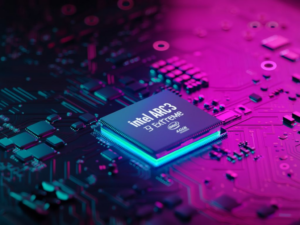
Intel is making strides in the gaming handheld market with its new Arc G3 Extreme chip, designed specifically for this segment. This marks a notable shift from previous attempts, particularly the MSI Claw, which struggled against AMD’s offerings.
Background on Intel’s Previous Handheld Efforts
The original MSI Claw, launched in early 2024, was Intel’s first serious attempt at a Windows gaming handheld. However, it faced severe criticism for its performance, particularly when compared to AMD’s Ryzen Z1 Extreme. Reviewers highlighted its inefficiency and poor gaming experience, largely due to inadequate drivers and suboptimal hardware.
Introducing the Arc G3 Extreme
Fast forward two years, and Intel is showcasing the Arc G3 Extreme, which is featured in the Acer Predator Atlas 8. This chip is part of Intel’s first processor family tailored for handheld gaming PCs. According to Intel’s internal benchmarks, it outperforms AMD’s current flagship, the Ryzen Z2 Extreme.
The Arc G3 Extreme is built on the Panther Lake architecture and is manufactured using Intel’s new 18A process. It features a 14-core CPU paired with the Arc B390 integrated GPU, which includes 12 Xe3 cores. The chip operates within a power range of 8W to 35W, emphasizing efficiency—a critical factor for handheld devices.
Performance and Driver Improvements
Intel’s previous handhelds suffered from poor driver support, which has since improved significantly. The company has committed to providing day-one driver support for new releases, addressing past criticisms. The Arc G3 Extreme boasts a 50% performance increase over its predecessor, the Xe2, and offers 40% better performance per watt, which is crucial for handheld gaming.
During a brief hands-on at Computex, the Acer Predator Atlas 8 demonstrated impressive performance, running Forza Horizon 6 at a consistent 60 FPS in native 1920×1200 resolution. However, this performance was observed in a controlled environment, and independent verification is still needed.
Challenges Ahead for Intel
Despite these advancements, Intel faces significant challenges in the handheld market. AMD’s dominance is not solely due to chip performance; it also stems from a robust ecosystem, including SteamOS support and widespread adoption of technologies like FSR. Until Intel can establish a similar foothold, its success remains uncertain.
As of now, the Acer Predator Atlas 8 is set to launch in October, but pricing details are still undisclosed. Until independent testing and pricing confirmation occur, Intel’s comeback story remains a work in progress.
This article was produced by NeonPulse.today using human and AI-assisted editorial processes, based on publicly available information. Content may be edited for clarity and style.
Original source: xda-developers.com