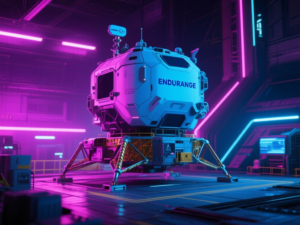
In a significant milestone for lunar exploration, Blue Origin’s lunar lander, known as Endurance, has successfully passed its most challenging test yet at NASA’s Chamber A, one of the largest thermal vacuum facilities globally. This facility is designed to simulate the extreme conditions of space, providing a crucial environment for testing spacecraft intended for the Moon and beyond.
The testing in Chamber A is not merely a procedural step; it is essential for verifying the lander’s viability in the harsh lunar environment. The Moon presents extreme temperature fluctuations, with daytime highs reaching 120 degrees Celsius and nighttime lows plummeting to -130 degrees Celsius. Without an atmosphere to moderate these conditions, any spacecraft must be thoroughly tested to ensure it can withstand such extremes.
Engineers utilize Chamber A to recreate the vacuum of space and the severe thermal cycling that vehicles will encounter during their missions. This process ensures that every system, seal, and material performs as expected under conditions where there is no atmospheric support.
Endurance is an uncrewed cargo lander developed under a reimbursable Space Act Agreement with NASA, exemplifying a public-private partnership that allows commercial entities to leverage NASA’s advanced facilities while managing costs and risks. The mission serves as a demonstration flight aimed at validating the technologies necessary for future crewed lunar landings as part of NASA’s Artemis program.
The lander is equipped with critical technologies that enable precise landing capabilities, including cryogenic propulsion systems and autonomous guidance, navigation, and control systems. These technologies are vital for ensuring safe landings on the lunar surface, especially when human lives are at stake.
Endurance is set to carry two NASA science payloads to the lunar South Pole under the Commercial Lunar Payload Services initiative. One of these payloads includes high-resolution stereo cameras designed to capture images of the interaction between the lander’s engine plume and the lunar surface during descent. This data will help engineers understand the complex dynamics of landing on the Moon. The second payload is a laser retroreflector array, which will enhance positional measurements on the lunar surface by reflecting laser light from orbiting spacecraft.
Looking ahead, Blue Origin is already in the process of developing the Blue Moon Mark 2, a larger crewed lander intended to transport astronauts from lunar orbit to the surface and back. This next-generation lander aims to support a sustained human presence at the Moon’s South Pole, a region believed to contain valuable water ice in permanently shadowed craters.
This article was produced by NeonPulse.today using human and AI-assisted editorial processes, based on publicly available information. Content may be edited for clarity and style.