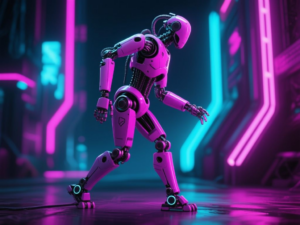
The Shadow Walker, a headless and armless bipedal robot, emerged from the creative minds of a hobbyist group in the late 1980s. This project was spearheaded by Richard Greenhill, a British photographer with a passion for robotics, who began building the robot in his attic after failing to convince his colleagues at Intergalactic Robots to pursue the idea.
In 1987, Greenhill gathered a group of enthusiasts, known as the Shadow Group, to collaborate on various robotics projects. Their primary focus became the two-legged Shadow Walker, which was designed with a simplified skeletal structure based on human anatomy. The robot stood 168 centimeters tall, weighed approximately 38 kilograms, and utilized a unique method of movement.
Pneumatic Muscles in Action
Instead of conventional motors, the Shadow Walker employed compressed air to control its movements through 28 air-muscles. These muscles, inspired by the McKibben muscle concept from the 1950s, allowed the robot to mimic human muscle contractions. The robot’s design included a maple skeleton with only one bone in the lower leg and a single wide toe on each foot, providing it with 12 degrees of freedom across eight joints.
Challenges in Mobility
Despite achieving stability and balance, the Shadow Walker faced significant challenges in walking. Rich Walker, a teenager who joined the group, developed software to help the robot maintain its stance, utilizing neural networks to address balancing issues. However, hardware limitations, such as unreliable sensors and fragile components, hindered its progress.
A Historic Showcase
In 1990, the Shadow Walker participated in the inaugural International Robot Olympics held in Glasgow. This event aimed to showcase the capabilities of various robots from around the world. Despite high hopes, the Shadow Walker failed to walk, and the bipedal competition was won by a robot from Cardiff University. Ultimately, the Shadow Walker now resides in the Science Museum in London, a testament to its innovative design and the spirit of DIY robotics.
In 1997, the Shadow Group transitioned into a registered company, Shadow Robot, which has since become a leader in robotic hand technology. While the focus has shifted from walking robots to dexterous hands, the legacy of the Shadow Walker continues to inspire advancements in the field of robotics.
This article was produced by NeonPulse.today using human and AI-assisted editorial processes, based on publicly available information. Content may be edited for clarity and style.