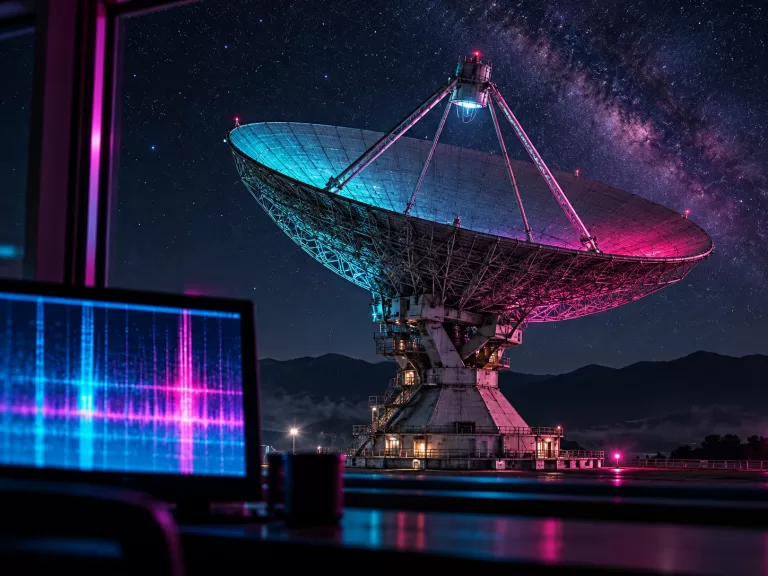
The quest for extraterrestrial intelligence (SETI) continues to raise profound questions about our place in the cosmos, particularly in light of Fermi’s Paradox. This paradox highlights a striking contradiction: given the vastness of the universe and the abundance of conditions suitable for life, why have we not yet encountered evidence of intelligent civilizations?
Understanding Fermi’s Paradox
Fermi’s inquiry, famously phrased as “Where is Everybody?”, stems from several key observations. The universe is approximately 13.8 billion years old, with an observable diameter of about 96 billion light-years. It contains over 2 trillion galaxies, each with varying populations of stars. The essential elements for life—carbon, hydrogen, nitrogen, oxygen, phosphorus, sulfur (collectively known as CHNOPS)—are widely available. Given these factors, it seems logical to conclude that life, and potentially intelligent life, should be common.
The Great Silence
Despite these favorable conditions, humanity has not detected definitive evidence of extraterrestrial visitors. This absence of contact is referred to as the Great Silence. The implications of this silence have led to various hypotheses attempting to explain why we have not yet made contact with other intelligent beings.
Proposed Explanations
Two notable physicists, Michael Hart and Frank Tipler, formalized early responses to Fermi’s Paradox in the 1970s and 1980s. Hart’s 1975 paper, Explanation for the Absence of Extraterrestrials on Earth, posited that if advanced civilizations existed, they would have colonized the galaxy within two million years. Tipler’s 1981 work, Extraterrestrial Intelligent Beings Do Not Exist, suggested a longer timeline of 300 million years for galactic colonization. Both concluded that the lack of evidence for extraterrestrial life implied its non-existence.
In response, renowned astronomer Carl Sagan, along with William Newman, argued in their 1983 paper, The Solipsist Approach to Extraterrestrial Intelligence, that absence of evidence does not equate to evidence of absence. They critiqued the assumptions made by Hart and Tipler, particularly regarding the speed of interstellar travel and the replication rates of self-replicating probes.
The Great Filter Hypothesis
Another significant concept in this discourse is the Great Filter, proposed by Robin Hanson in 1996. This hypothesis suggests that there exists a barrier preventing intelligent life from advancing to a stage where it can communicate or travel across interstellar distances. Hanson outlined a nine-step process required for life to evolve into a space-faring civilization, emphasizing that at least one of these steps must be improbable. This could range from challenges in abiogenesis to catastrophic events that threaten advanced civilizations.
Philosopher Nick Bostrom further elaborated on the Great Filter, describing it as a probability barrier that must be surpassed for intelligent civilizations to emerge. The implications of this theory are profound: while humanity may have the potential to expand across the universe, the current silence suggests that many civilizations may not survive long enough to achieve such a state.
By the end of the 20th century, SETI faced a precarious future, especially after the cancellation of NASA’s High Resolution Microwave Survey in 1993. However, the field has since matured, with renewed interest and public-private partnerships revitalizing efforts to explore the cosmos for signs of intelligent life.
This article was produced by NeonPulse.today using human and AI-assisted editorial processes, based on publicly available information. Content may be edited for clarity and style.
Original source: universetoday.com