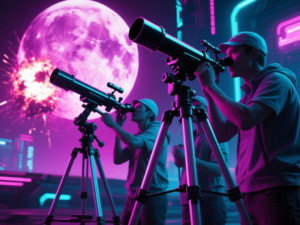
As NASA’s Artemis II astronauts orbited the Moon in early April, they recorded flashes of light resulting from meteoroids striking the lunar surface. Concurrently, volunteers participating in the Impact Flash project utilized their telescopes to capture and send videos of these events to scientists, enriching the data collected from space.
Ben Fernando, a planetary scientist at Los Alamos National Laboratory and lead of the Impact Flash project, expressed gratitude for the contributions from volunteers. The combination of observations from both the astronauts and Earth-based telescopes allows researchers to better understand the characteristics and origins of the impactors, as well as the craters they create.
Continued Observations Needed
Although the Artemis II mission has concluded its lunar observations, the Impact Flash team is eager for ongoing public participation. Individuals with telescopes measuring four inches in diameter or larger, equipped with video capabilities, are encouraged to contribute their observations. The more data collected, the more accurately the team can assess the current impact rate on the Moon and its variations over time.
Future Research Directions
The Impact Flash project aims to leverage the data from these impact observations to investigate lunar tremors, known as moonquakes. These seismic events can provide insights into the Moon’s internal structure. Fernando noted, “We are planning to send seismometers to the Moon to measure how the ground shakes.” The data collected from impact flashes will be instrumental in identifying the sources of moonquakes, thereby enhancing our understanding of the Moon’s interior.
Collaborative Efforts in Data Collection
During the Artemis II mission, the Impact Flash team collaborated with various groups of amateur astronomers, including the NASA-funded Kilo-nova Catchers, Exoplanet Watch, UNITE (Unistellar Network Investigating TESS Exoplanets), and the Night Sky Network, as well as the Lunar Impact Flashes project from the National Research Council of Italy (IMATI-CNR). This collaborative effort underscores the importance of citizen science in advancing planetary research.
For those interested in participating, instructions for making and submitting observations can be found on the Impact Flash website. The project acknowledges the contributions of various researchers and organizations that support this initiative, including the Italian Space Agency and the European Space Agency’s Lunar Meteoroid Impacts Observer mission.
This article was produced by NeonPulse.today using human and AI-assisted editorial processes, based on publicly available information. Content may be edited for clarity and style.