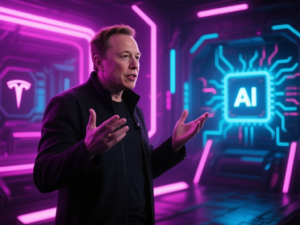
Elon Musk has announced Tesla’s plans to develop its own AI chips utilizing Intel’s not-yet-finished 14A manufacturing process. This revelation came during Tesla’s latest earnings call, where Musk emphasized the necessity of producing AI silicon at scale through the company’s forthcoming “Terafab” initiative.
Strategic Partnership with Intel
Musk stated, “Intel is excited to partner with us on some of the core manufacturing technologies,” indicating a collaborative effort between Tesla and Intel. The 14A process, which is still under development, is positioned as a critical component of Tesla’s strategy to secure a reliable supply of AI chips. Musk expressed confidence that by the time Terafab is operational, the 14A process will be sufficiently mature.
Addressing Supply Chain Concerns
Musk framed the initiative as a response to urgent supply chain challenges, asserting, “We don’t see a path to having enough sufficient quantity of AI chips down the road… we just anticipate hitting the wall if we don’t make chips ourselves.” This statement underscores Tesla’s concerns about future chip availability, which is crucial for its AI and autonomous vehicle ambitions.
Financial Context and Market Positioning
Despite Tesla’s ongoing success in vehicle sales, the company reported a decline in revenue and profits, with margins under pressure due to rising costs and increased spending on AI and manufacturing. This financial backdrop adds weight to Musk’s rationale for pursuing in-house chip production as a means to support Tesla’s transition from a traditional automotive company to a tech-driven entity focused on autonomy and AI.
Long-Term Vision and Challenges Ahead
Musk also hinted at potential innovations in AI chip design, noting, “We do have some ideas for how to make maybe radically better AI chips,” although he acknowledged these are still in the research phase and represent a long shot. The ambitious plans extend beyond chip production, with Musk reiterating Tesla’s goals in robotaxi services and humanoid robots, positioning these developments as integral to the company’s future.
As Tesla prepares to invest tens of billions into chips, robots, and autonomous systems, the reliance on an unfinished manufacturing process raises questions about the feasibility of these expansive plans. Musk’s confidence in navigating these challenges reflects his characteristic optimism, even as the stakes continue to rise.
This article was produced by NeonPulse.today using human and AI-assisted editorial processes, based on publicly available information. Content may be edited for clarity and style.