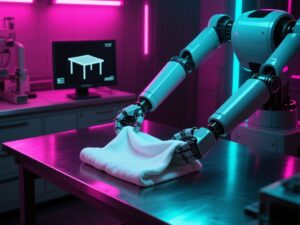
A dual-arm laboratory robot faced three ordinary jobs: move plates into a tote, fold towels and scan barcodes. After adaptation, it completed 10 of 10 plate trials, 8 of 10 towel trials and 8 of 10 barcode trials. Together, that made 26 successes out of 30 physical evaluations. The result comes from a September 30 arXiv preprint, not an independently replicated or peer-reviewed finding.
The striking part was the physical practice budget: the SimEX authors say each adaptive method received about ten minutes of robot interaction per task. That does not mean the whole project took ten minutes. Simulation, computation, setup, model calls, evaluation and human labor sat outside that figure. SimEX: Simulation-Integrated Robotics AutoResearch
The real work began before the robot touched the table
Before the physical trials, a coding agent built and revised a reusable software toolbox inside an imperfect simulation. Physical feedback then exposed failures that the agent could repair and screen again in simulation before another real attempt. The paper says simulation-only abilities did not directly solve some deployment tasks; a physical trial and repair improved performance. SimEX: Simulation-Integrated Robotics AutoResearch
The enduring mechanism is a loop: simulate possible fixes, test selected behavior on the robot, bring failures back into simulation and try again. That can reduce costly physical trial and error, but it does not eliminate the simulated work or the need for real-world checks.
A person still reset the scene
The robot was not left alone to manage the experiment. A human operator reset the scene between every physical adaptation trial. The authors also identify the single robot platform and manual resets as limitations. The report demonstrates a laboratory workflow, not unattended autonomy. SimEX: Simulation-Integrated Robotics AutoResearch
A fast test is not the same as a general skill
The 26 successes are trials across three task types, not 26 different tasks. The strongest listed baseline achieved no more than three successful physical trials across the same 30 evaluations, but that comparison remains the authors’ reported result rather than an independent replication. SimEX: Simulation-Integrated Robotics AutoResearch
The broader problem is longstanding. Google DeepMind has described imperfect transfer from simulated dexterity to real-world performance, while Stanford’s iGibson researchers identified generalization across environments as an unresolved issue. Those efforts provide context, not a directly comparable benchmark. Our latest advances in robot dexterity A Simulated Playground for Robots
The next test changes the room
If the same simulation-first process works on different robot bodies, unfamiliar rooms and new objects, it could reduce the physical time needed to teach narrowly defined manipulation skills. If performance collapses outside this platform and these controlled scenes, the ten-minute figure will remain a useful laboratory result rather than a route to household robots.