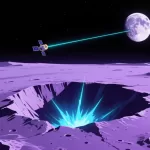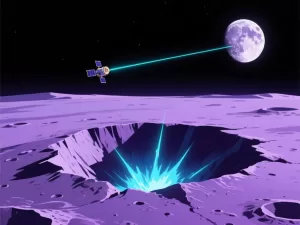
A crater about 222 meters wide and 43 meters deep formed on the Moon between April 11 and May 22, 2024. No Earth- or space-based telescope detected the impact as it happened. The change emerged on October 24, 2025, when Lunar Reconnaissance Orbiter image specialist Robert Wagner compared before-and-after mosaics. The report does not demonstrate that existing systems could have detected it in real time; it shows that a large event went unnoticed until the terrain was compared afterward. NASA — Moon Orbiter Spots New, Once-in-Century Moon Crater Science Advances — A new 222-m diameter lunar crater Associated Press — NASA spacecraft discovers a huge new crater on the moon
The hole was only the beginning
The crater, called McGetchin, is described as the largest recently identified impact crater in the solar system. Researchers estimate that an impact of this magnitude occurs on the Moon roughly once per century or longer. That is a statistical estimate, not a timetable for the next strike. NASA — Moon Orbiter Spots New, Once-in-Century Moon Crater Science Advances — A new 222-m diameter lunar crater Associated Press — NASA spacecraft discovers a huge new crater on the moon
Its wider footprint matters for future lunar activity. Ejecta and secondary effects disturbed the surface for more than 100 kilometers, far beyond the crater itself. A future habitat outside the rim would not automatically be safe simply because it avoided a direct hit, although the risk to any specific site has not yet been calculated. Science Advances — A new 222-m diameter lunar crater Associated Press — NASA spacecraft discovers a huge new crater on the moon
The ground kept a thermal record
LRO's Diviner instrument found an approximately 7-kilometer-wide area around the crater that is about 9 degrees Celsius cooler at night than nearby terrain. Researchers interpret that cold spot as loosened, lower-density regolith, the powdery surface layer that holds less heat. The impact therefore changed the ground's physical behavior beyond the visible edge of the crater. NASA — Moon Orbiter Spots New, Once-in-Century Moon Crater Science Advances — New lunar crater reveals extensive distal regolith modification
A harder planning problem for the Moon
The enduring mechanism is straightforward: a fast impact excavates a crater, throws material outward and rearranges the surface over a much larger area. Future lunar planners may need to account for that spread, not only the chance of a direct strike. Researchers identify calculating ejecta risk to infrastructure as a next step; no cited study reports damage to an existing base. Science Advances — A new 222-m diameter lunar crater Science Advances — New lunar crater reveals extensive distal regolith modification Associated Press — NASA spacecraft discovers a huge new crater on the moon
For now, the discovery exposes a monitoring gap. Even a large change in lunar terrain may become known only through patient comparison of orbital records. As construction moves toward the Moon, the open question is whether site selection and shielding can turn delayed detection into useful preparation. NASA — Moon Orbiter Spots New, Once-in-Century Moon Crater Associated Press — NASA spacecraft discovers a huge new crater on the moon