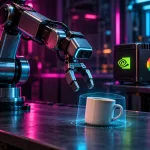
Imagine asking a robot to clear a table after someone has moved the cups. Recognizing the request is only the beginning: it must locate each object, choose a grip and adjust as the scene changes. That gap between understanding an instruction and carrying it out is where physical AI comes into focus.
On October 20, Google Cloud outlined a platform connecting robot simulation, model training and real-world operation. A day later, TÜV SÜD and Accenture presented a safety-assessment concept for automated factories and warehouses. Together, these announcements illustrate an engineering push beyond conversational software.
What physical AI actually does
NVIDIA describes physical AI as enabling machines to perceive, understand and act in the physical world. The central idea is a feedback loop: observe the surroundings, select an action, execute it and check what changed.
A remotely switched lamp follows a command. An adaptive robot must also interpret a changing scene and select movements within its capabilities. The distinction is not simply whether a device has Wi-Fi or an AI-branded chip.
The model can help connect a broad goal to individual movements. In its September 2025 Gemini Robotics 1.5 announcement, Google DeepMind described separate models for task planning and for converting visual information and instructions into motor commands. This is earlier technical context, not a product unveiled this week.
Does the robot need its own brain?
Some processing can happen directly on the machine. DeepMind’s June 2025 On-Device model was designed to operate without a data connection, including demonstrations such as folding clothes. Those demonstrations do not establish reliable performance in every home or workplace.
Local execution and cloud services can also coexist. Google Cloud’s October explanation explicitly combines cloud-scale planning with fast local execution, alongside hybrid and offline deployments. There is no single rule requiring every part of the intelligence to live inside the robot.
Before deployment, simulation lets developers rehearse tasks and failures without repeatedly risking physical equipment. But simulated success still needs real-world validation, a gap illustrated by NeonPulse’s earlier coverage of simulation-assisted robot learning.
Capability is only half the test
The Physical AI Safety Suite concept announced October 21 uses NVIDIA technologies to assess layouts, robot fleets and individual machines. It considers site-specific conditions such as loads, lighting and floor surfaces, with TÜV SÜD retaining responsibility for certification. It is a proposed assessment approach, not proof that any AI-equipped robot is safe.
DeepMind also describes pairing its models with low-level safety-critical controllers. A model’s proposed action and the mechanisms that constrain physical movement are distinct parts of the system.
For a buyer or operator, the useful questions are concrete: under which conditions has the machine been tested, what happens when its perception fails, and what can stop an unsafe action? Physical AI promises more adaptable machines. Its practical value depends on what they can do reliably when the room stops looking like the demonstration.