A new U.S. Surgeon General advisory puts children’s screen use under a wide lens, from development and learning to physical health, mental health and sleep. But its warning does not make every minute equivalent. The same screen can carry different content, happen at different times and either interrupt family attention or become part of it. The advisory also recognizes that digital media can have benefits. U.S. Surgeon General’s Advisory: Warning on the Harms of Screen Use The Harms of Screen Use
That distinction matters because a new England brief offers a number that looks simple but is not. Caregivers reported that two-year-olds watched screen content for an average of 127 minutes a day; including computer games, the average reached 140 minutes. The researchers found an association between higher screen time and lower measured vocabulary, but explicitly said the study could not identify causal factors directly. It does not show that screens caused the difference. Children of the 2020s: home learning environment and screen time at age 2 Excessive screen time could limit vocabulary of toddlers, experts warn
The missing activity may be the clue
The more revealing comparison was not only between children with more or less screen time. The brief found larger unadjusted differences in language scores across groups defined by home-learning activities than across screen-time groups. Reading, talking, singing and playing do not become automatically protective in every household, but their presence shows why a total-minute measure can hide the day around the screen. Children of the 2020s: home learning environment and screen time at age 2
This is displacement: time spent watching may coincide with less sleep, conversation, physical activity or shared attention. It is a mechanism to examine, not a proven explanation for every association. The cohort also found that more screen use was independently associated with lower income, lower caregiver education and caregiver depressive symptoms. Those conditions complicate any story in which the device alone is treated as the cause. Children of the 2020s: home learning environment and screen time at age 2
A number cannot carry the whole story
For families, the practical test is therefore more specific than counting minutes. What was on the screen? Was an adult involved? Did it happen before bed? What activity was crowded out? A short video that delays bedtime and a shared call with relatives may occupy similar time while carrying different circumstances. The available evidence does not justify diagnosing an individual child from a population average.
The advisory recommends screen-free times, avoiding devices before sleep, adult role-modeling and alternatives such as physical activity. WHO guidance recommends no more than one hour of sedentary screen time for children aged two to four, alongside guidance on movement and sleep. These are population recommendations, not proof that occasional screen use is inherently harmful. The Harms of Screen Use Guidelines on physical activity, sedentary behaviour and sleep for children under 5 years of age
The real household tradeoff
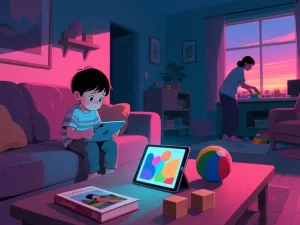
In an evening room, a tablet may occupy a toddler while a caregiver handles dinner, or it may sit between a child and a picture book, a ball or an earlier bedtime. Both scenes can produce the same tally. The enduring mechanism is not the glowing object by itself but the allocation of scarce family time and attention. The evidence supports asking what disappeared before declaring what the screen did.
That leaves a harder and more useful question than whether screens are simply good or bad: when digital media enters a child’s day, which parts of that day remain protected—and which quietly give way?