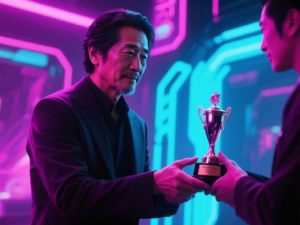
Toshio Fukuda, a distinguished figure in the realm of robotics, has recently been awarded the IEEE Richard M. Emberson Award for his extensive contributions to the field. With over 2,000 research papers and several influential books to his name, Fukuda’s work spans various domains, including **biomedical robotic systems**, **industrial robots**, **micro-nano robotics**, and **AI-driven automation**.
A Legacy of Innovation
Fukuda’s influence is underscored by his role in establishing one of the first robotics conferences, the **IEEE/RSJ International Conference on Intelligent Robots and Systems (IROS)**, which continues to thrive nearly 40 years after its inception. Currently serving as a vice president of research at the **Egypt-Japan University of Science and Technology**, Fukuda has held various prestigious positions, including the presidency of IEEE in 2020, marking a historic moment as the first person of Asian descent to do so.
Recognition and Awards
His contributions have not gone unnoticed; Fukuda has received numerous accolades, including Japan’s **Medal of Honor with a purple ribbon** in 2015 and the **Order of the Sacred Treasure** in 2022. The IEEE Board-level award he received on April 24 in New York City recognizes his “distinguished service advancing the technical objectives of IEEE, especially in the area of robotics.”
Path to Robotics
Fukuda’s journey into robotics began in his youth, where he developed a passion for building devices like transistor radios. This interest led him to pursue engineering, culminating in a bachelor’s degree from **Waseda University** in 1971, followed by a master’s and doctorate from the **University of Tokyo**. His academic pursuits included time at **Yale University**, where he explored advanced control theory.
Innovative Robotic Systems
Among Fukuda’s notable achievements is the creation of **CEBOTs**, modular robotic systems introduced in 1985. These autonomous cells can connect and detach, forming complex structures to perform various tasks. Today, CEBOTs are utilized in diverse applications, such as delivering medication in hospitals and assisting in agricultural tasks.
Fukuda’s work also includes the development of **brachiation robots**, inspired by the swinging motion of monkeys, which are now employed in inspecting high-voltage transmission towers and conducting maintenance tasks. His career reflects a commitment to advancing robotics for practical applications, ensuring that technology serves the needs of society.
This article was produced by NeonPulse.today using human and AI-assisted editorial processes, based on publicly available information. Content may be edited for clarity and style.