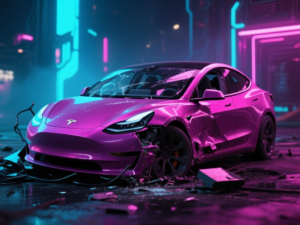
A recent crash involving a Tesla Model 3 has raised serious questions about the safety of the company’s automated driving features. The incident, which occurred in Texas, resulted in the death of 76-year-old Martha Avila, prompting her family to file a lawsuit against Tesla and the driver.
The lawsuit, submitted in Harris County District Court, seeks over $1 million in damages. The family alleges that the vehicle’s Full Self Driving (FSD) system was defective. Michael Butler, the driver at the time of the crash, reported to police that the automated driving feature was engaged when he lost control of the vehicle. Authorities are currently investigating whether FSD was indeed active during the incident.
Claims of Defective Technology
Tesla has publicly denied that its technology was responsible for the crash. Elon Musk stated on social media that the high-speed nature of the crash contradicts the typical operation of FSD, which is designed to navigate residential areas at lower speeds. Tesla’s vice president of AI software, Ashok Elluswamy, suggested that Butler manually overridden the self-driving system by fully pressing the accelerator, reaching speeds of 73 mph before the crash.
Allegations of Sudden Unintended Acceleration
The family’s lawsuit presents two primary theories regarding the crash. The first involves a phenomenon known as Sudden Unintended Acceleration (SUA), which the family claims Tesla has failed to address despite its history of causing serious accidents. SUA can occur when the vehicle’s systems misinterpret signals, potentially leading to rapid and uncontrolled acceleration.
The second theory posits that due to a global chip shortage, Tesla may have removed essential obstacle-detection hardware from its vehicles, which could have prevented the Model 3 from recognizing the house at the end of the street. The lawsuit states that Butler was operating the vehicle in a foreseeable manner with FSD engaged when it failed to detect the obstacle.
Investigation and Evidence Preservation
The National Highway Traffic Safety Administration (NHTSA) has confirmed it is investigating the crash, which may support the family’s claims regarding the design and functionality of Tesla’s Autopilot and FSD systems. So far, police have found no evidence of mechanical failure.
The family has requested that Tesla preserve all relevant evidence, including the vehicle’s black box data, sensor information, and the car itself in its post-collision condition for further examination. They aim to ensure accountability and prevent similar incidents in the future.
In the aftermath of the crash, the family expressed gratitude to the first responders who attempted to save Avila’s life. They continue to seek clarity on the role Tesla’s technology may have played in this tragic event.
This article was produced by NeonPulse.today using human and AI-assisted editorial processes, based on publicly available information. Content may be edited for clarity and style.
Original source: arstechnica.com