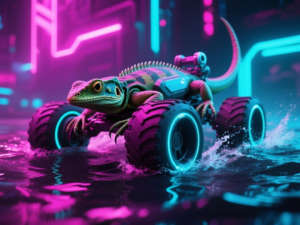
In a remarkable fusion of biology and engineering, researchers have designed rover wheels that emulate the swimming motion of the sandfish skink, a lizard adept at navigating through sand. This innovative approach promises to enhance the ability of future Mars rovers to traverse the planet’s challenging surface.
Biomimicry in Robotics
Nature’s adaptations serve as a profound source of inspiration for technological advancements. The sandfish skink, known for its unique locomotion, has become a focal point for a team at the University of Würzburg, led by Professor Marco Schmidt. This initiative is part of the VaMEx project under the German Aerospace Centre, aiming to refine the design of rover wheels.
Performance Testing
The newly developed wheels have undergone testing, demonstrating superior performance compared to conventional rover wheels when traversing sandy environments. Amenosis Lopez, a researcher in Schmidt’s group, noted that traditional wheel designs often struggle with soft ground, leading to slippage and entrapment. In contrast, the sandfish-inspired wheels do not roll in the conventional sense, allowing them to glide more effectively over sand.
Mechanics of Movement
These innovative wheels generate both longitudinal and lateral forces, mimicking the sandfish’s interaction with the ground. The testing results revealed that the rover leaves sinusoidal tracks in the sand, confirming the success of the swimming mechanism. Initial designs faced challenges, as the first iterations were narrower and heavier, resulting in slippage. However, the latest versions are lighter and wider, significantly improving their performance on sandy terrain.
Future Developments
While the new wheels excel in sandy conditions, the diverse Martian landscape presents additional challenges, including rocky and mixed terrains. Researchers are focused on refining the wheel surface to enhance performance across these varied environments. The European Space Agency’s upcoming Rosalind Franklin rover, scheduled for launch in 2028, will not utilize these innovative wheels, as its design has already been finalized. However, the ESA is planning another mission to Mars in 2035, which may incorporate the perfected sandfish wheels, should the agency successfully land a rover on the Martian surface.
This article was produced by NeonPulse.today using human and AI-assisted editorial processes, based on publicly available information. Content may be edited for clarity and style.
Original source: universetoday.com