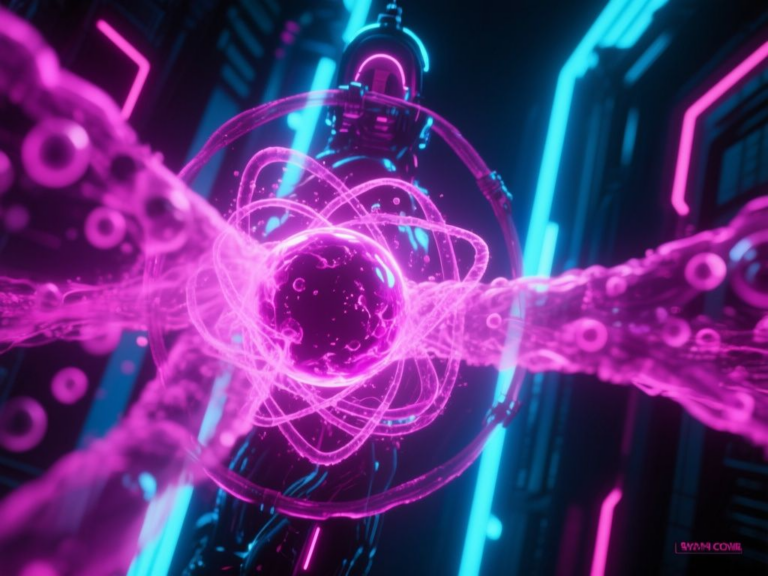
In the realm of quantum mechanics, the concept of quantum superposition stands as one of the most fascinating and perplexing phenomena. It challenges our classical intuitions about the nature of reality, suggesting that particles can exist in multiple states at once. This paradoxical behavior raises profound questions about the very fabric of the universe.
Defining Quantum Superposition
At its core, quantum superposition refers to the ability of a quantum system—such as an electron or a photon—to be in a combination of different states simultaneously. For example, rather than being in a single position, a particle can exist in multiple locations at once until it is measured. This is fundamentally different from classical physics, where objects are only found in one state at a time.
It is essential to clarify what quantum superposition is not. It does not imply that particles are merely uncertain about their state; rather, they genuinely exist in a blend of states. This phenomenon is mathematically represented by a wave function, which encodes all possible states of the system. When a measurement is made, the wave function collapses, and the particle assumes a definite state.
How Quantum Superposition Works
The mechanics of quantum superposition can be illustrated through a well-known analogy: the Schrödinger’s cat thought experiment. Imagine a cat placed in a sealed box with a radioactive atom. If the atom decays, it triggers a mechanism that kills the cat; if it does not decay, the cat remains alive. According to quantum mechanics, until the box is opened and observed, the cat is considered to be both alive and dead simultaneously—existing in a superposition of states.
This analogy highlights the counterintuitive nature of quantum mechanics. The cat’s fate is tied to the behavior of a quantum particle, which can exist in a superposition of decayed and undecayed states. Only upon observation does the system collapse into one of the two definitive outcomes. This illustrates how quantum superposition operates on a fundamental level, revealing the strange and often unintuitive nature of the quantum world.
Trade-offs of Quantum Superposition
Quantum superposition offers remarkable advantages, particularly in the field of quantum computing. By leveraging superposition, quantum bits, or qubits, can represent multiple values simultaneously, significantly enhancing computational power. This capability allows quantum computers to solve complex problems much faster than classical computers.
However, this power comes with trade-offs. The delicate nature of superposition makes quantum systems highly susceptible to decoherence, where interactions with the environment cause the system to lose its quantum properties. Maintaining superposition requires extreme conditions, such as ultra-low temperatures or isolation from external disturbances, which can complicate practical applications.
Limitations and Bottlenecks
Despite its potential, quantum superposition faces significant limitations. One major bottleneck is decoherence, which disrupts the delicate balance required for superposition to persist. When a quantum system interacts with its environment, it can collapse into a single state, effectively losing the advantages of superposition. This challenge necessitates the development of error-correcting codes and robust isolation techniques to maintain quantum states.
Another bottleneck is the scalability of quantum systems. While small-scale quantum systems have demonstrated superposition, scaling these systems up to a level where they can perform practical computations remains a significant challenge. The complexity of managing multiple qubits while preserving their quantum properties is a critical hurdle that researchers are actively working to overcome.
Real-World Use Cases
Quantum superposition is not merely a theoretical concept; it has practical applications that are beginning to emerge. One prominent use case is in quantum computing, where superposition allows qubits to perform calculations at unprecedented speeds. This capability could revolutionize fields such as cryptography, optimization, and complex simulations, enabling solutions to problems that are currently intractable for classical computers.
Another application lies in quantum sensing. Devices that exploit quantum superposition can achieve sensitivity levels far beyond classical sensors. For instance, quantum sensors can detect gravitational waves or measure magnetic fields with extraordinary precision, opening new avenues for exploration in fundamental physics and beyond.
In conclusion, quantum superposition embodies the paradox of existing in multiple states, challenging our understanding of reality. While it offers transformative potential in technology and science, the limitations and complexities associated with maintaining superposition present ongoing challenges. As research progresses, the implications of quantum superposition will continue to unfold, revealing deeper insights into the nature of the universe.
This article was produced by NeonPulse.today using human and AI-assisted editorial processes. Content may be edited for clarity and style.