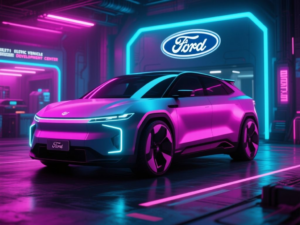
Ford is navigating a challenging landscape for electric vehicles (EVs) in the U.S., particularly with the federal tax credit’s removal and rising component costs. Despite these hurdles, the company is committed to advancing its electric vehicle offerings with the introduction of the Universal Electric Vehicle (UEV) platform, announced in late 2025.
The UEV platform is designed to be highly modular, supporting a range of Ford’s future electric vehicles. Most of the development work is taking place at Ford’s Electric Vehicle Development Center (EVDC) in Long Beach, California, which aims to revolutionize vehicle development processes.
The Skunkworks Concept
Located in a nondescript building near Long Beach Airport, the EVDC operates under the principles of a skunkworks—a term originating from Lockheed Martin’s secretive division known for rapid innovation. The EVDC’s structure is intended to minimize bureaucratic obstacles, allowing for quicker decision-making and development cycles.
Alan Clarke, vice president of Advanced Development Projects, leads the EVDC, supported by a team that includes many former Tesla employees. This leadership structure is designed to foster a culture of autonomy and rapid iteration.
Operational Efficiency
The EVDC emphasizes a small, agile workforce, with around 350 employees on-site, which can expand to about 480 with external collaborations. This compact team structure is crucial for maintaining speed and flexibility in the development process.
Equipped with advanced tools such as 3D printers and a large CNC mill, the facility enables rapid prototyping and in-house design adjustments. This capability allows teams to iterate quickly without the delays associated with external manufacturing.
Cost-Effective Design Strategies
Cost management is a priority for the UEV program. Ford is focusing on design decisions that minimize production costs, such as using the battery pack as a structural component of the chassis. This approach reduces the need for additional materials and simplifies assembly processes.
While details about the first vehicle based on the UEV platform remain limited, Ford’s strategies appear to prioritize efficiency and affordability. The EVDC’s innovative practices may significantly influence the future of electric pickups, potentially enhancing EV adoption in the U.S.
This article was produced by NeonPulse.today using human and AI-assisted editorial processes, based on publicly available information. Content may be edited for clarity and style.