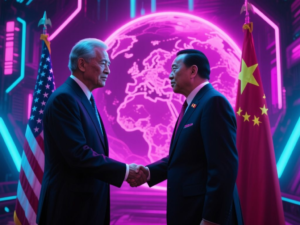
In a recent seminar at MIT, former U.S. ambassador to China, Nicholas Burns, underscored the critical role of U.S.-China relations in addressing global challenges, particularly climate change. He highlighted the two nations as the largest carbon emitters, stressing the necessity for cooperation to benefit both countries.
U.S.-China Competition: A Complex Landscape
Burns, now the Goodman Professor of the Practice of Diplomacy and International Relations at Harvard University, characterized the relationship between the United States and China as competitive, tough, and adversarial. He identified four primary areas of contention: military, technology, trade and economics, and values. This competitive dynamic complicates the landscape for diplomatic engagement.
Trade Tensions and Economic Implications
Trade relations are particularly fraught, with Burns noting that both nations aspire to be the dominant global economy. He referenced significant trade wars in 2025, which saw tariffs soar to 145% by the U.S. and 125% by China, creating substantial friction. Such tariffs, if maintained, could have led to a complete halt in trade between the two countries.
Energy Sector Dynamics
Burns pointed out that the energy sector is heavily influenced by U.S.-China competition, especially regarding rare earth elements, essential for technologies like lithium batteries and solar panels. He noted that in 2024 and 2025, multiple countries, including India and members of the EU, imposed tariffs on these products, echoing U.S. actions. Burns supported efforts to diversify sources of rare earths, aligning with strategies from both the Trump and Biden administrations.
Technological Rivalry and Educational Disparities
The technological competition between the U.S. and China is also pivotal, with Burns praising China’s focus on STEM education. He highlighted a stark contrast: 36% of Chinese first-year university students major in STEM fields compared to just 5% in the U.S. This disparity raises concerns about the U.S.’s ability to maintain a competitive edge in emerging technologies like artificial intelligence and quantum computing.
Burns concluded by emphasizing the importance of managing competition to protect national interests while fostering peace. He argued for normalizing communication between the two nations to mitigate risks associated with their significant global influence.
This article was produced by NeonPulse.today using human and AI-assisted editorial processes, based on publicly available information. Content may be edited for clarity and style.