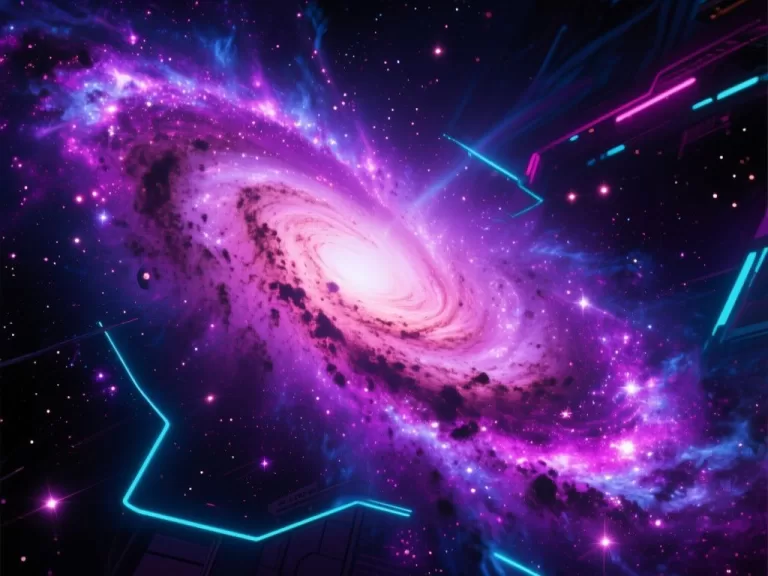
The Milky Way, with its dark lanes of dust, presents a formidable challenge for astronomers and cosmologists alike. This cosmic dust, while a byproduct of stellar evolution, complicates the study of the universe by contaminating light and obscuring observations.
In the vastness of interstellar space, approximately 99% of the matter consists of simple hydrogen and helium, with the remaining fraction categorized as dust—microscopic clumps of heavier elements such as carbon, oxygen, and iron. These elements are forged in the hearts of stars, leading to the common yet misleading notion of “stardust.” In reality, dust is a significant impediment to astronomical observations.
The Nature of Cosmic Dust
Dust grains vary in size, with the smallest measuring just a few nanometers and the largest reaching about a thousandth of a millimeter. Each grain is unique, composed of different elements and arranged in various configurations. This variability affects how dust interacts with light, leading to complex scattering and absorption behaviors. Some wavelengths of light are scattered, redirecting photons and blurring images of distant galaxies. Others are absorbed, diminishing brightness, while some are emitted as infrared radiation when heated.
Impact on Astronomical Measurements
The sheer volume of dust in space complicates observations. For instance, light from an object located 1,000 light-years away must traverse a significant amount of dust, which can vary in density and composition along different lines of sight. A typical galaxy, like the Milky Way, contains around 100 million solar masses of dust. If all this dust were collected, it could theoretically form 100 million suns, although it would not function effectively as stars.
This pervasive dust means that no astronomical observation is entirely untainted. Dust dims light, selectively reduces certain wavelengths, and scatters photons, leading to inaccuracies in measurements of distance and color. Historically, this has resulted in significant errors in stellar distance calculations, particularly before the 1930s. Astronomer Robert Trumpler demonstrated that the assumption of unobstructed views was fundamentally flawed, revealing that the galaxy was smaller than previously thought and altering our understanding of its structure.
Dust as a Persistent Challenge
Every astronomer grapples with the need to model dust’s effects on their observations. The standard approach involves combining laboratory measurements of dust interactions with light and observing targets across multiple wavelengths. Different wavelengths respond differently to dust, with visible light being scattered more than near-infrared or far-infrared light. By comparing observations across the spectrum and fitting them against laboratory models, astronomers can estimate the amount and type of dust obstructing their view.
However, this method is not foolproof and often comes with significant error margins. A notable example of dust’s impact occurred in 2014 when the BICEP2 collaboration claimed to have detected primordial gravitational waves in the cosmic microwave background. This groundbreaking discovery was later challenged by the Planck satellite team, which revealed that the observed signal was largely influenced by local galactic dust, leading to a retraction of the initial claims.
As astronomers continue to confront the challenges posed by cosmic dust, they must navigate the complexities it introduces to their observations and measurements, underscoring the intricate relationship between dust and our understanding of the universe.
This article was produced by NeonPulse.today using human and AI-assisted editorial processes, based on publicly available information. Content may be edited for clarity and style.
Original source: universetoday.com