The Universe is an incomprehensibly vast and ancient expanse, originating from the Big Bang approximately 14 billion years ago. Current estimates suggest there are over 2 trillion galaxies within the observable Universe, many containing up to a trillion stars. Our own galaxy, the Milky Way, is home to between 100 and 400 billion stars and 100 to 160 billion planets. Given the abundance of the essential ingredients for life, scientists are compelled to ponder the existence of life beyond Earth.
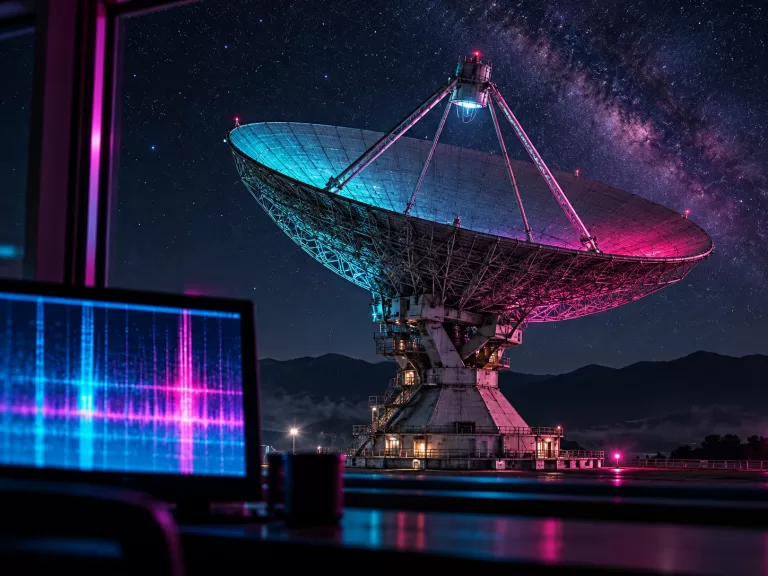
The search for extraterrestrial life, particularly intelligent life, began in earnest with the advent of modern astronomy in the late 19th and early 20th centuries. Initially focused on nearby celestial bodies such as the Moon, Mars, and Venus, these efforts have since expanded to encompass the broader cosmos. As technology has advanced, the methods employed have diversified from radio astronomy to include optical and thermal observations.
Motivations Behind the Search
One fundamental question arises: why search for extraterrestrial life at all? The potential scientific returns from discovering evidence of technological activity, or technosignatures, are immense. During the Cold War, both sides of the Iron Curtain invested in SETI initiatives, driven by the fear that the first to make contact with an alien civilization could gain a significant technological advantage. Additionally, the low-cost nature of SETI experiments, which often utilize existing radio and optical observatories, makes this pursuit feasible.
Perhaps the most profound reason for this search is the potential impact on humanity’s understanding of its place in the Universe. The realization that we are not alone could inspire future generations to think beyond terrestrial confines and consider our existence in a cosmic context.
The Fermi Paradox
In 1950, physicist Enrico Fermi famously posed the question, “Where is everybody?” during a conversation at Los Alamos National Laboratory. This remark, made amidst discussions about UFOs, highlighted a critical paradox: if intelligent life exists, why have we not yet observed it? Fermi’s inquiry led to calculations regarding the probabilities of extraterrestrial civilizations and their potential visitation to Earth, laying the groundwork for what is now known as the Fermi Paradox.
Early SETI Initiatives
Defining the origins of the search for extraterrestrial life is complex. The distinction between passive SETI—listening for signals—and active SETI—sending messages into space—has evolved over time. The first active SETI proposal is attributed to mathematician Carl Friedrich Gauss, who suggested creating a large petroglyph to communicate with extraterrestrial beings. Meanwhile, Nikola Tesla’s 1899 experiments in Colorado Springs are often cited as an early instance of passive SETI, where he believed he detected a signal from Mars.
Other early efforts included the work of radio pioneers like Guglielmo Marconi and Thomas Edison, who reported signals they thought originated from outer space. The campaign for National Radio Silence Day in 1924, which encouraged people to turn off radios to listen for signals from Mars, further exemplifies the early interest in SETI. Historians generally agree that the formal discipline of SETI began in 1960 with the first dedicated experiment aimed at detecting transmissions from another solar system.
Stay tuned for part two, where the details of this groundbreaking experiment will be revealed!
This article was produced by NeonPulse.today using human and AI-assisted editorial processes, based on publicly available information. Content may be edited for clarity and style.
Original source: universetoday.com