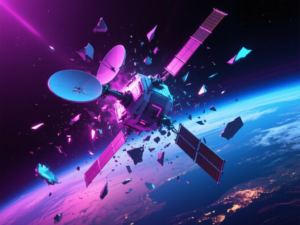
SpaceX’s Starlink division announced that it lost contact with a satellite, designated Starlink 34343, on Sunday. The satellite appears to have broken apart into at least tens of pieces, prompting the company to investigate the potential space debris produced by this incident.
In a post on X, Starlink stated that there seemed to be “no new risk” to other space operations, refraining from using the term “explosion.” However, the situation is concerning, as the satellite was one of approximately 10,000 Starlink satellites currently in orbit.
Detection of Fragmentation
Radar network operator LeoLabs reported detecting a fragment creation event involving Starlink 34343. Their Global Radar Network first identified the fragments during a pass over their radar site in the Azores, Portugal. They noted that additional fragments may still be produced as analysis continues.
LeoLabs indicated that the breakup was likely due to an internal energetic source rather than a collision with another object or space debris. Given the low altitude of the event, which occurred at approximately 560 km above Earth, the fragments are expected to de-orbit within a few weeks.
Monitoring Ongoing Risks
Starlink confirmed that the anomaly posed no new risks to the International Space Station, its crew, or the upcoming NASA Artemis II mission. The company is actively monitoring the satellite and any trackable debris, coordinating with both NASA and the US Space Force.
Starlink also reassured that the event did not affect the Transporter-16 mission, which was designed to avoid Starlink satellites during payload deployment.
Historical Context and Future Actions
This incident is reminiscent of a previous anomaly on December 17, 2025, which also resulted in the creation of multiple fragments. LeoLabs noted that both events appeared to stem from internal energetic sources rather than external collisions.
After the December incident, Starlink reported that the satellite experienced venting of its propulsion tank and a rapid decay in its orbit. The company expressed confidence in its ability to identify and mitigate the root causes of such anomalies, stating that engineers were already deploying software to enhance protections against similar events.
As the number of satellites in orbit continues to grow, the importance of coordination among satellite operators becomes increasingly critical. Starlink has emphasized the need for improved communication to reduce collision risks, especially as it plans to expand its constellation significantly.
This article was produced by NeonPulse.today using human and AI-assisted editorial processes, based on publicly available information. Content may be edited for clarity and style.
Original source: arstechnica.com