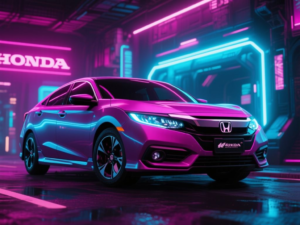
Honda has been recognized as the leading fuel-efficient automaker in the United States, as highlighted in the recent U.S. Environmental Protection Agency (EPA) Automotive Trends Report. This report provides an extensive analysis of fuel economy and vehicle technology data from the U.S. light-duty vehicle market, covering the years from 1975 to 2024, along with preliminary data for 2025.
Since its inception, the EPA has collected data on every new light-duty vehicle model sold in the U.S., utilizing tests conducted at the National Vehicle and Fuel Emissions Laboratory or directly from manufacturers following official EPA procedures. The report indicates that the 2025 Honda Civic leads gasoline vehicles with a combined fuel economy of 36.6 mpg, a notable improvement from the 1975 Honda Civic, which had a real-world fuel economy of 28.3 mpg.
Honda’s Fleet Performance
Honda’s fleet now averages 31 miles per gallon, surpassing the industry average by 3.8 mpg. This achievement is significant, especially as the average price of new vehicles has surged to around $50,000. In contrast, the average price for a new Honda in 2025 was reported at $35,060, making it a more accessible option for consumers.
Honda’s pricing strategy remains competitive, with popular models such as the top-tier Touring Hybrid configuration for the 2026 Honda Accord starting under $41,000. The 2026 Ridgeline Black Edition is priced below $49,000, and the EX-L trim for the 2026 HR-V starts around $31,000.
Market Trends and Fuel Economy
The EPA report also notes that the average real-world fuel economy for new vehicles has reached a record high of 27.2 mpg, reflecting a 41% increase since 2004. However, the shift towards larger vehicles, such as SUVs, which now account for 60% of production, has partially offset improvements in fuel economy.
Despite these trends, Honda remains focused on sustainability through its Triple Action to ZERO initiative, aiming for zero environmental impact by 2050. This strategy encompasses carbon neutrality, clean energy usage, and total resource circulation, with the Saitama Factory in Japan set to become Honda’s first carbon-neutral plant by March 2026.
Regulatory Changes
In February 2026, the EPA finalized a rule that removed greenhouse gas standards for various vehicle classes, which has implications for the data included in the latest Automotive Trends Report. Nonetheless, Honda continues to prioritize its sustainability goals amidst these regulatory changes.
This article was produced by NeonPulse.today using human and AI-assisted editorial processes, based on publicly available information. Content may be edited for clarity and style.