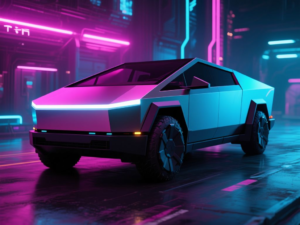
In a strategic move to increase sales, Tesla has implemented substantial price cuts for its Cybertruck lineup. The tri-motor variant, dubbed the “Cyberbeast,” now retails for $99,990, reflecting a $15,000 decrease. This reduction comes alongside the removal of certain previously included features, such as supercharging and Full Self-Driving (FSD) capability.
A new entry-level model has been introduced at a price point of $59,990. This dual-motor configuration offers a range of 325 miles (523 km) and matches the 0–60 mph acceleration time of 4.1 seconds found in the more expensive all-wheel drive version priced at $79,990. This pricing adjustment makes the entry-level model a competitive option within the Cybertruck range.
Previously, Tesla had launched a single-motor rear-wheel drive variant, which was priced at $69,990 but was discontinued due to low demand. The new dual-motor model is now available for $10,000 less, providing a more appealing option for potential buyers.
To accommodate the new pricing structure, Tesla has made several adjustments to the specifications. While the range and acceleration remain consistent with the pricier dual-motor Cybertruck, the towing capacity has been reduced from 11,000 lbs (4,990 kg) to 7,000 lbs (3,175 kg), and the cargo capacity has decreased from 2,500 lbs (1,134 kg) to 2,006 lbs (910 kg). Additionally, the vehicle now features steel springs and adaptive dampers, replacing the previously standard air suspension.
Interior changes include textile seats, but the entry-level model lacks seat ventilation for the front row and seat heaters for the second row. Other modifications involve a different console design, the absence of AC outlets in the cabin, and a reduction in the number of speakers, omitting the active noise-cancellation system.
Despite these adjustments, the entry-level Cybertruck is still priced $20,000 higher than the initial $39,900 figure promised by Elon Musk during the vehicle’s unveiling in 2019. The production of the Cybertruck has faced significant challenges, with Musk acknowledging that the company has struggled with the design and manufacturing processes.
Sales figures for the Cybertruck have been disappointing, with fewer than 39,000 units sold in 2024 and just over 20,000 in 2025. This performance contrasts sharply with Musk’s earlier projections of selling 250,000 trucks annually by 2025, indicating a disconnect with both traditional pickup buyers and electric vehicle enthusiasts.
This article was produced by NeonPulse.today using human and AI-assisted editorial processes, based on publicly available information. Content may be edited for clarity and style.
Original source: arstechnica.com