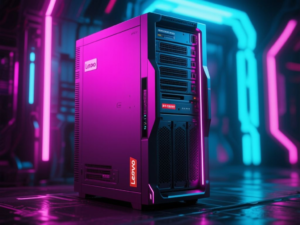
Lenovo has unveiled its new FX series of hyperconverged appliances, designed to assist organizations in transitioning from VMware to alternative hypervisors. This move comes as many businesses are exploring cloud repatriation strategies, opting for on-premises hyperconverged or private cloud solutions.
Market Dynamics and Customer Sentiment
Kumar Mitra, executive director for Lenovo Infrastructure Solutions Group in Central Asia Pacific, Australia, and New Zealand, noted that a significant number of customers are seeking pathways to exit the VMware platform. Mitra stated, “A lot of customers are looking for a pathway to move off the VMware platform,” indicating a shift in customer sentiment towards more flexible infrastructure options.
FX Series Features and Capabilities
The FX series is positioned as a versatile solution, capable of running both VMware and Nutanix stacks. This flexibility allows users to switch between platforms as needed, a feature that Mitra emphasized by saying, “FX is a pretty emphatic proposition for proof-of-concept projects because it can handle multiple hyperconverged platforms.” Lenovo’s approach aims to reduce vendor lock-in, catering to organizations that prefer not to be tied to a single platform.
Challenges in Migration
While the FX series is designed to facilitate migration, Mitra acknowledged the complexities involved in moving away from VMware. He remarked, “It is easier said than done, as users have built a lot of skills around VMware and it is a brilliant product.” This sentiment reflects the challenges organizations face when dismantling established VMware-heavy management systems.
Industry Insights and Future Considerations
Independent analyst Michael Warrilow highlighted that 2025 saw minimal progress in enterprise-scale VMware migrations, suggesting that organizations should prepare for a multi-hypervisor environment. He advised that transitioning will require time and investment but is essential for long-term success. Warrilow also pointed out that development environments could be optimized to reduce VMware license costs, emphasizing the need for organizations to adapt to new IT infrastructure models.
Lenovo’s FX series not only targets businesses looking to diversify their hypervisor usage but also incorporates features like liquid cooling to support AI workloads, indicating a forward-looking approach to infrastructure design.
This article was produced by NeonPulse.today using human and AI-assisted editorial processes, based on publicly available information. Content may be edited for clarity and style.