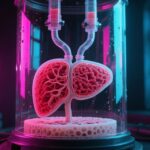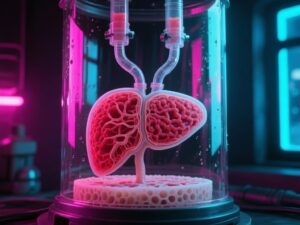
“A liver that doesn’t require a donor match”: that is how Xiling Shen describes Prometheus in Terasaki’s project announcement, dated October 2, 2026. The universal bioprinted liver project has an ARPA-H award of up to $19.8 million, with a start date of July 31, 2026. It remains an engineering plan, with no completed transplantable liver or human clinical result reported in the announcement.
A universal bioprinted liver begins with engineered cells
Prometheus starts with induced pluripotent stem cells from an allogeneic source, engineered to be hypoimmunogenic. In plain terms, the team is trying to create liver cells that can be used across patients while provoking less immune attack than an ordinary unmatched transplant. That is a proposed property, not a demonstrated clinical outcome; the report does not demonstrate that rejection has been eliminated. ARPA-H’s Prometheus award Terasaki’s project announcement
The cells would then be expanded in bioreactors and assembled through porous-bed bioprinting. The intended endpoint is transplantable liver tissue. The team says it must scale the biological material, add structural and vascular support, and move oxygen and nutrients through the tissue by perfusion. ARPA-H’s Prometheus award Terasaki’s project announcement
A liver cannot live on the surface
This is the central mechanism behind the project’s difficulty: cells deep inside a thick organ need a working supply network. ARPA-H identifies thick vascularized tissue, printing speed, post-print cell viability and complex organ structure as open biofabrication problems. A printed shape can look like an organ while still failing as one if its inner cells die or lose their function. PRINT technical roadmap
The practical consequence is stark for patients waiting on liver replacement: a promising universal graft would matter only if it survives manufacturing, implantation and the immune response. Prometheus plans laboratory-model transplants to assess engraftment, function and regenerative capacity. Those tests are future work, not reported results. Terasaki’s project announcement
The money buys a sequence of tests
Prometheus sits inside ARPA-H’s broader PRINT program, which separates the challenge into cell generation, large-scale manufacturing, biofabrication and safety testing. The program’s 2024 technical roadmap sets targets including roughly 10 billion cells per organ, more than 90 percent purity for defined cell types, storage viability above 85 percent, large-animal safety and efficacy studies, and pre-IND documentation. These are program targets, not milestones Prometheus has already met. The pre-IND documentation is a package prepared for discussions with regulators before human trials. PRINT program overview PRINT technical roadmap
Five years can show whether the bet survives
In January 2026, ARPA-H announced a PRINT funding ceiling of $176.8 million over five years, contingent on milestones, for competing routes toward liver and kidney tissue. That announcement described a human-sized printed organ with normal function as a feat still to be achieved; it is not a current audit of every team’s progress. NeonPulse’s conditional scenario for July 2031—five years after Prometheus’s listed award start—is a graft that clears large-animal safety and efficacy work and supports a pre-IND package—not routine hospital availability. That scenario depends on sustained funding, safe cell expansion and working perfusion. Rejection, tumor formation or tissue death at scale would undermine it. The decisive question is whether the engineered cells, perfused tissue and manufacturing process hold together at organ scale. ARPA-H’s January portfolio announcement PRINT technical roadmap