The prospect of human cities on the Moon has captivated imaginations since the dawn of the space age. However, a recent study raises critical questions about the feasibility of such ambitious plans, particularly regarding the availability of water.
Understanding Lunar Water Resources
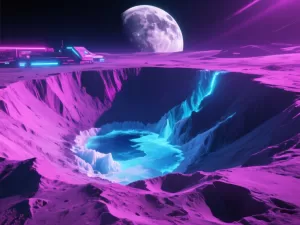
The Moon’s Permanently Shadowed Regions (PSRs) are of particular interest due to their potential to harbor ancient water ice. A new article published in Frontiers in Space Technologies by Dr. Martin Elvis and Dr. Jonathan McDowell examines the implications of these resources for lunar habitation. They argue that while the Moon is often referred to as our “8th continent,” the reality of its water resources is far more complex.
Water Availability and Sustainability
Dr. Elvis and Dr. McDowell estimate that there may be around one billion tons of water ice in the Moon’s PSRs, a figure they consider generous. However, this amount pales in comparison to Earth’s vast reserves, which total approximately 1.4 billion billion tons. The authors emphasize that the sustainability of a lunar city hinges on not just the quantity of water but also its accessibility and the efficiency of recycling systems.
Using a consumption estimate of 125 tons of water per person per year for personal use, they calculate that a city of one million people could exhaust the Moon’s water supply in just 2.4 years. Even with advanced recycling techniques, such as those employed on the International Space Station (ISS), which achieved 98% efficiency in 2023, a city of this size would only last about 100 years before depleting its water resources.
Energy Considerations
While energy sources for lunar settlements, such as solar and fission power, are deemed less of a constraint, the authors note that energy is still a critical factor in extracting and recycling water. They suggest that the ideal locations for solar power generation are the rims of craters, which receive ample sunlight. This could facilitate the energy needs for water extraction and processing.
Future Implications
The study concludes that a more realistic lunar population may be closer to 1,000, akin to the number of researchers in Antarctica, rather than the ambitious figures proposed by some billionaires. The authors stress the importance of planning and regulating lunar water use to avoid unsustainable practices. Ultimately, they assert that finding additional water sources, possibly from underground reservoirs or asteroids, will be essential for any long-term lunar settlement.
Original source: universetoday.com
This article was produced by NeonPulse.today using human and AI-assisted editorial processes, based on publicly available information. Content may be edited for clarity and style.