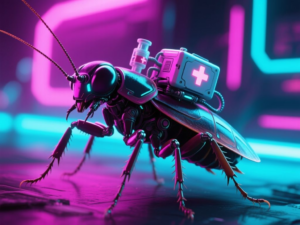
In a remarkable blend of biology and technology, researchers at the University of Queensland have transformed giant burrowing cockroaches into cybernetic entities known as Paraborgs. These remote-controlled insects are designed to deliver vital medical supplies in disaster situations, potentially aiding victims trapped under rubble.
Innovative Rescue Technology
The Paraborgs are equipped with lightweight electronics, including electrodes implanted in their antennae and cerci, which allow for precise control using a handheld gaming controller. This setup enables operators to steer the cockroaches left or right, propel them forward, or halt their movement. The researchers have also integrated either a wireless camera or a remote-controlled injector, which can launch a drug-filled syringe at a target.
Proven Capabilities
In proof-of-concept trials, the Paraborgs successfully navigated a 2.5-meter course, hitting an 8-by-10-centimeter silicone target with a 72 percent success rate in delivering injections across 25 trials. This performance underscores the potential of these cyborgs to assist in real-world rescue operations.
Addressing Challenges
While the technology shows promise, the researchers acknowledge several challenges remain. The unpredictability of the living insects poses a unique hurdle, as they retain control over their locomotion despite electrical stimulation. Future developments will focus on enhancing the Paraborgs’ autonomy, improving their ability to navigate complex environments, and ensuring reliable communication in disaster zones.
Future Implications
Vo-Doan, the director of the Biorobotics Lab, emphasizes that while the Paraborgs are not yet ready for deployment in real disaster scenarios, they could inform the design of future robotic systems. The integration of living insects with technology may provide insights that lead to more effective artificial solutions.
As the researchers continue to refine their approach, they are also considering how to make the presence of these cyborgs less alarming to victims. Suggestions include using flashing lights or audible messages to indicate their role in rescue efforts. The findings were published in the journal Advanced Science last month, marking a significant step forward in the intersection of robotics and emergency response.
This article was produced by NeonPulse.today using human and AI-assisted editorial processes, based on publicly available information. Content may be edited for clarity and style.