Cherenkov radiation, a phenomenon discovered by Pavel Cherenkov in 1934, has proven to be significantly more than a scientific curiosity. It manifests in various critical contexts, including nuclear reactors, cosmic ray detection, and medical imaging technologies.
Cherenkov Radiation in Nuclear Reactors
One of the most striking examples of Cherenkov radiation occurs in nuclear reactors, where fuel rods submerged in water emit a distinctive blue glow. This glow results from high-energy electrons and decay products traveling faster than light in water, leaving behind a cone of blue light. This phenomenon is a rare instance of a relativistic effect visible to the naked eye, providing a direct visual representation of particles outracing light.
Cosmic Rays and Atmospheric Detection
The universe has been producing Cherenkov radiation long before its discovery. Cosmic rays, high-energy particles from supernovae and other cosmic events, interact with Earth’s atmosphere, generating cascades of secondary particles that also exceed the speed of light in air. This interaction produces faint cones of Cherenkov light, which are continuously present in the upper atmosphere but remain undetectable from the ground due to their faintness.
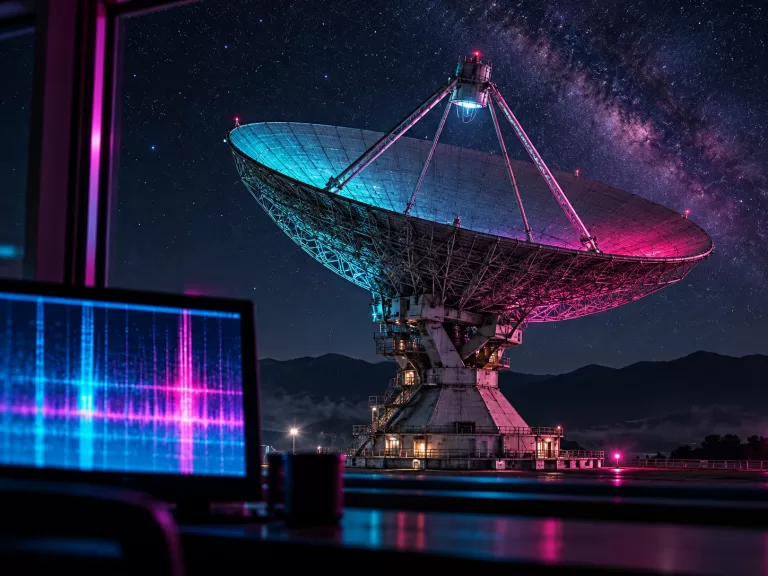
To observe these elusive flashes, scientists utilize Imaging Atmospheric Cherenkov Telescopes (IACTs), which are strategically placed at high-altitude locations. These telescopes detect the brief Cherenkov flashes created when high-energy gamma rays from space collide with the atmosphere. Major instruments like MAGIC, H.E.S.S., and VERITAS have successfully mapped the gamma-ray sky, revealing phenomena such as supernova remnants and active galactic nuclei.
IceCube Neutrino Observatory
One of the most ambitious applications of Cherenkov radiation is found in the IceCube Neutrino Observatory located at the South Pole. This facility, spanning a cubic kilometer of Antarctic ice, is designed to detect neutrinos—particles that interact very weakly with matter. IceCube is equipped with over 5,000 optical sensors that monitor for Cherenkov radiation produced when a high-energy neutrino interacts with an atomic nucleus, creating a charged particle that travels faster than light in ice. By analyzing the light patterns, physicists can determine the neutrino’s origin, providing insights into violent cosmic events.
Cherenkov Radiation in Medical Imaging
In the medical field, Cherenkov radiation plays a vital role in positron emission tomography (PET) scans. When a radioactive tracer decays, it emits positrons that annihilate upon contact with electrons, producing gamma rays that travel faster than light in human tissue. The resulting Cherenkov radiation aids in pinpointing the location of the tracer, allowing for the identification of tumors and assessment of metabolic activity.
From its initial observation to its diverse applications today, Cherenkov radiation has transformed our understanding of both the universe and medical diagnostics. It exemplifies how scientific discoveries can evolve into essential tools across multiple disciplines.
This article was produced by NeonPulse.today using human and AI-assisted editorial processes, based on publicly available information. Content may be edited for clarity and style.
Original source: universetoday.com